Advanced Crypto
On-Chain Analysis
On-chain analysis uses public blockchain data to study user behavior, wallet flows, and network activity so analysts can better understand how markets and ecosystems are evolving. It helps readers connect reading blockchain data and whale tracking while keeping the core tradeoffs and risks in view. It can provide useful context, but it should never be treated as a perfect trading signal because big wallets move for many reasons, including custody changes, internal routing, OTC settlement, and strategic positioning.
TL;DR
Learn how wallet activity, exchange flows, and network metrics can be used to interpret market behavior and ecosystem health. It clarifies reading blockchain data, whale tracking, and transaction metrics so the lesson fits into the bigger advanced crypto picture.
Reading blockchain data
On-chain analysis uses public blockchain records to understand how users, traders, and large holders are behaving. Because the data is transparent, analysts can track activity patterns in a way that is unusual in traditional markets. That visibility is powerful, but it is not self-explanatory. A transfer on-chain tells you that something happened, not automatically why it happened. The skill in on-chain analysis is turning visible activity into useful context without pretending every wallet movement is a clear signal.
**On-Chain Analysis** becomes easier to understand when you translate it into a user flow instead of a definition. In practice, learners usually meet this idea while *comparing Ethereum mainnet congestion with lower-cost activity on rollups*, then discover that the visible app action sits on top of wallet permissions, network rules, liquidity, or settlement assumptions that are easy to miss the first time. That is why the safest beginner habit is to ask how the action works, what the hidden dependency is, and what part of the system would fail first under stress.
A common beginner mistake here is *memorizing jargon without mapping the tradeoff underneath it*. Another is *assuming the most decentralized design is always the most usable design*. Those errors usually do not come from bad intent; they come from skipping one layer of understanding and moving straight to the transaction. What can go wrong depends on the lesson, but the pattern is consistent: users either trust the wrong tool, underestimate timing and fees, or assume one network's rules apply everywhere. Slowing down long enough to verify the route, asset, counterparty, or contract address prevents a surprising share of early losses.
A useful way to test whether this idea is landing is to picture where it shows up in a real workflow. Someone might run into it while *comparing Ethereum mainnet congestion with lower-cost activity on rollups* or *reading token incentives to understand why a protocol can grow fast and still break later*, which is why the topic matters most once money, permissions, or liquidity are already in motion instead of while reading definitions in the abstract.
**Why this matters:** On-Chain Analysis is more useful when you can connect it to Crypto Market Cycles, How Blockchains Work, and Crypto Trading Basics. That broader map helps beginners judge when the tool fits, when a simpler path is safer, and which follow-on topic to study next before committing real money or signing real transactions.
For primary-source context, see [Bitcoin developer guide](https://developer.bitcoin.org/), [Ethereum smart contracts docs](https://ethereum.org/developers/docs/smart-contracts/), and [Arbitrum rollup overview](https://arbitrum.io/rollup).
Whale tracking
Whale tracking looks at the behavior of very large wallets to spot accumulation, distribution, or unusual transfers. It can provide useful context, but it should never be treated as a perfect trading signal because big wallets move for many reasons, including custody changes, internal routing, OTC settlement, and strategic positioning. The value of whale tracking is contextual, not magical. A large movement can be worth noticing, especially when it lines up with exchange flows or broader market stress, but copying whale behavior blindly is usually a shortcut to weak analysis.
The real value of **whale tracking** is that it explains what is happening behind the button a beginner clicks. Whether someone is *reading token incentives to understand why a protocol can grow fast and still break later* or *using on-chain data, liquidity conditions, and narrative shifts together instead of in isolation*, the outcome depends on a chain of infrastructure choices such as custody, routing, execution, and final settlement. Once that chain is clear, the topic stops feeling like crypto magic and starts feeling like a system with understandable moving parts.
Most people do not get hurt by the concept itself. They get hurt by the shortcuts they take around it. *Assuming the most decentralized design is always the most usable design* can turn a simple workflow into an expensive mistake, and *reading a single metric as if it explains the whole market* often becomes visible only after funds are already in motion. That is why good crypto education pairs the mechanics with practical failure modes instead of teaching the upside in isolation.
Beginners usually retain this faster when they attach it to a concrete decision rather than a glossary term. In practice, the concept becomes easier to trust and easier to question once you connect it to a workflow like *reading token incentives to understand why a protocol can grow fast and still break later* and ask what could break, slow down, or become expensive at each step.
**Why this matters:** On-Chain Analysis is more useful when you can connect it to Crypto Market Cycles, How Blockchains Work, and Crypto Trading Basics. That broader map helps beginners judge when the tool fits, when a simpler path is safer, and which follow-on topic to study next before committing real money or signing real transactions.
Transaction metrics
Transaction counts, transferred value, exchange inflows, and realized profit or loss are examples of metrics analysts use to judge network activity. The best insights usually come from combining several indicators rather than relying on one number in isolation. A single metric can look strong while the bigger picture looks weak. High transaction count might reflect healthy usage, or it might reflect bots. Rising exchange inflows might suggest selling pressure, or they might reflect repositioning. Good analysis comes from triangulating multiple signals, not worshipping one dashboard number.
**On-Chain Analysis** becomes easier to understand when you translate it into a user flow instead of a definition. In practice, learners usually meet this idea while *using on-chain data, liquidity conditions, and narrative shifts together instead of in isolation*, then discover that the visible app action sits on top of wallet permissions, network rules, liquidity, or settlement assumptions that are easy to miss the first time. That is why the safest beginner habit is to ask how the action works, what the hidden dependency is, and what part of the system would fail first under stress.
Most people do not get hurt by the concept itself. They get hurt by the shortcuts they take around it. *Reading a single metric as if it explains the whole market* can turn a simple workflow into an expensive mistake, and *memorizing jargon without mapping the tradeoff underneath it* often becomes visible only after funds are already in motion. That is why good crypto education pairs the mechanics with practical failure modes instead of teaching the upside in isolation.
A useful way to test whether this idea is landing is to picture where it shows up in a real workflow. Someone might run into it while *using on-chain data, liquidity conditions, and narrative shifts together instead of in isolation* or *comparing Ethereum mainnet congestion with lower-cost activity on rollups*, which is why the topic matters most once money, permissions, or liquidity are already in motion instead of while reading definitions in the abstract.
**Why this matters:** On-Chain Analysis is more useful when you can connect it to Crypto Market Cycles, How Blockchains Work, and Crypto Trading Basics. That broader map helps beginners judge when the tool fits, when a simpler path is safer, and which follow-on topic to study next before committing real money or signing real transactions.
Network activity indicators
Indicators like active addresses, fee levels, new wallet creation, and smart contract usage can reveal whether a chain is attracting real engagement. Rising activity can support a bullish case, but context still matters because bots, airdrop farming, and speculative bursts can distort the picture. That is why network activity is best read as a probability-shaping input, not a verdict. Strong activity can improve the case for ecosystem health, but it still needs to be paired with token structure, market conditions, and real user behavior to mean something durable.
The real value of **network activity indicators** is that it explains what is happening behind the button a beginner clicks. Whether someone is *comparing Ethereum mainnet congestion with lower-cost activity on rollups* or *reading token incentives to understand why a protocol can grow fast and still break later*, the outcome depends on a chain of infrastructure choices such as custody, routing, execution, and final settlement. Once that chain is clear, the topic stops feeling like crypto magic and starts feeling like a system with understandable moving parts.
A common beginner mistake here is *memorizing jargon without mapping the tradeoff underneath it*. Another is *assuming the most decentralized design is always the most usable design*. Those errors usually do not come from bad intent; they come from skipping one layer of understanding and moving straight to the transaction. What can go wrong depends on the lesson, but the pattern is consistent: users either trust the wrong tool, underestimate timing and fees, or assume one network's rules apply everywhere. Slowing down long enough to verify the route, asset, counterparty, or contract address prevents a surprising share of early losses.
Beginners usually retain this faster when they attach it to a concrete decision rather than a glossary term. In practice, the concept becomes easier to trust and easier to question once you connect it to a workflow like *comparing Ethereum mainnet congestion with lower-cost activity on rollups* and ask what could break, slow down, or become expensive at each step.
**Why this matters:** On-Chain Analysis is more useful when you can connect it to Crypto Market Cycles, How Blockchains Work, and Crypto Trading Basics. That broader map helps beginners judge when the tool fits, when a simpler path is safer, and which follow-on topic to study next before committing real money or signing real transactions.
What on-chain data is good for
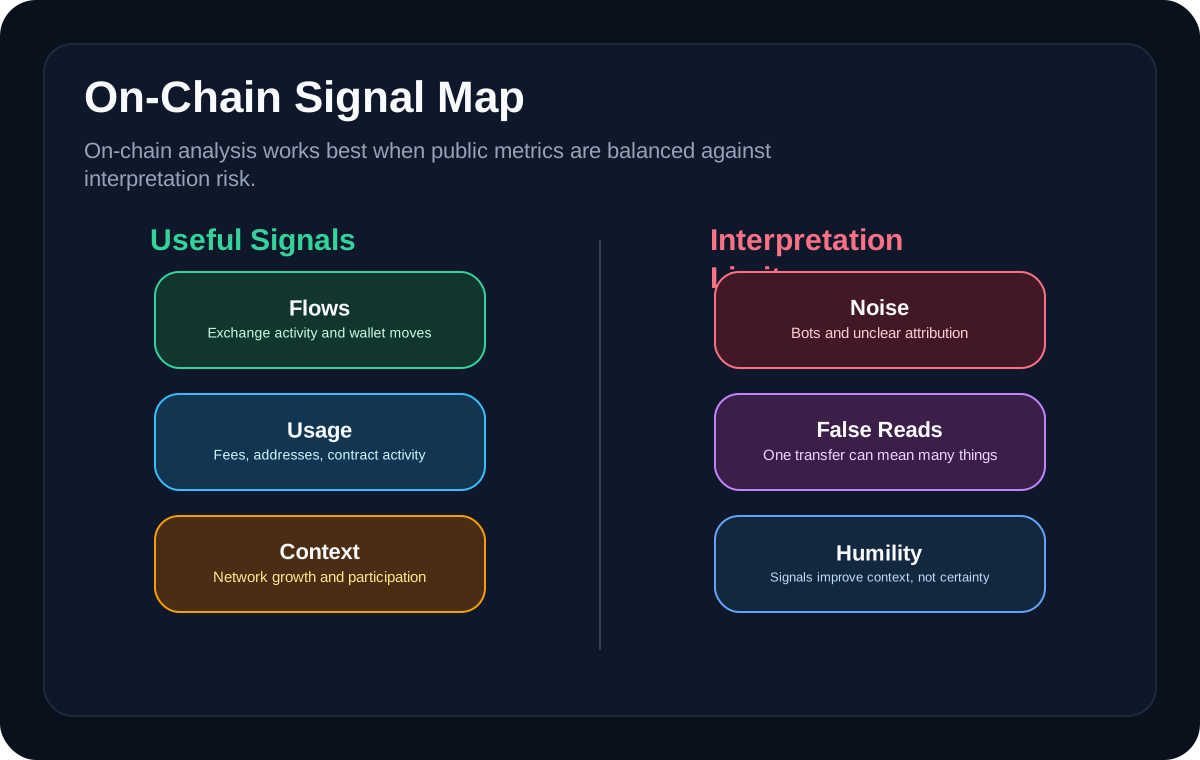
On-chain data is especially useful for seeing broad behavior that would be hidden in many traditional markets, such as exchange inflows, wallet concentration, fee activity, or network growth. Why this matters: it can improve context even when it does not produce a clean trading signal.
**On-Chain Analysis** becomes easier to understand when you translate it into a user flow instead of a definition. In practice, learners usually meet this idea while *reading token incentives to understand why a protocol can grow fast and still break later*, then discover that the visible app action sits on top of wallet permissions, network rules, liquidity, or settlement assumptions that are easy to miss the first time. That is why the safest beginner habit is to ask how the action works, what the hidden dependency is, and what part of the system would fail first under stress.
Most people do not get hurt by the concept itself. They get hurt by the shortcuts they take around it. *Assuming the most decentralized design is always the most usable design* can turn a simple workflow into an expensive mistake, and *reading a single metric as if it explains the whole market* often becomes visible only after funds are already in motion. That is why good crypto education pairs the mechanics with practical failure modes instead of teaching the upside in isolation.
A useful way to test whether this idea is landing is to picture where it shows up in a real workflow. Someone might run into it while *reading token incentives to understand why a protocol can grow fast and still break later* or *using on-chain data, liquidity conditions, and narrative shifts together instead of in isolation*, which is why the topic matters most once money, permissions, or liquidity are already in motion instead of while reading definitions in the abstract.
**Why this matters:** On-Chain Analysis is more useful when you can connect it to Crypto Market Cycles, How Blockchains Work, and Crypto Trading Basics. That broader map helps beginners judge when the tool fits, when a simpler path is safer, and which follow-on topic to study next before committing real money or signing real transactions.
Where on-chain analysis breaks down
On-chain data can be noisy because wallets are pseudonymous, bots can distort activity, and one visible transfer can have many possible motives. In simple terms: on-chain data is powerful, but it still needs interpretation and humility.
The real value of **where on-chain analysis breaks down** is that it explains what is happening behind the button a beginner clicks. Whether someone is *using on-chain data, liquidity conditions, and narrative shifts together instead of in isolation* or *comparing Ethereum mainnet congestion with lower-cost activity on rollups*, the outcome depends on a chain of infrastructure choices such as custody, routing, execution, and final settlement. Once that chain is clear, the topic stops feeling like crypto magic and starts feeling like a system with understandable moving parts.
Most people do not get hurt by the concept itself. They get hurt by the shortcuts they take around it. *Reading a single metric as if it explains the whole market* can turn a simple workflow into an expensive mistake, and *memorizing jargon without mapping the tradeoff underneath it* often becomes visible only after funds are already in motion. That is why good crypto education pairs the mechanics with practical failure modes instead of teaching the upside in isolation.
Beginners usually retain this faster when they attach it to a concrete decision rather than a glossary term. In practice, the concept becomes easier to trust and easier to question once you connect it to a workflow like *using on-chain data, liquidity conditions, and narrative shifts together instead of in isolation* and ask what could break, slow down, or become expensive at each step.
**Why this matters:** On-Chain Analysis is more useful when you can connect it to Crypto Market Cycles, How Blockchains Work, and Crypto Trading Basics. That broader map helps beginners judge when the tool fits, when a simpler path is safer, and which follow-on topic to study next before committing real money or signing real transactions.
Visual Guides
Glossary
- Reading blockchain data
- On-chain analysis uses public blockchain records to understand how users, traders, and large holders are behaving. Because the data is transparent, analysts can track activity patterns in a way that is unusual in traditional markets.
- Whale tracking
- Whale tracking looks at the behavior of very large wallets to spot accumulation, distribution, or unusual transfers. It can provide useful context, but it should never be treated as a perfect trading signal because big wallets move for many reasons, including custody changes, internal routing, OTC settlement, and strategic positioning.
- Transaction metrics
- Transaction counts, transferred value, exchange inflows, and realized profit or loss are examples of metrics analysts use to judge network activity. The best insights usually come from combining several indicators rather than relying on one number in isolation.
- Network activity indicators
- Indicators like active addresses, fee levels, new wallet creation, and smart contract usage can reveal whether a chain is attracting real engagement. Rising activity can support a bullish case, but context still matters because bots, airdrop farming, and speculative bursts can distort the picture.
FAQ
What is on-chain analysis in simple terms?
On-chain analysis uses public blockchain data to study user behavior, wallet flows, and network activity so analysts can better understand how markets and ecosystems are evolving.
Why does on-chain analysis matter in advanced crypto?
It matters because Rising activity can support a bullish case, but context still matters because bots, airdrop farming, and speculative bursts can distort the picture.
What should learners watch out for with on-chain analysis?
Watch for It can provide useful context, but it should never be treated as a perfect trading signal because big wallets move for many reasons, including custody changes, internal routing, OTC settlement, and strategic positioning.
How does on-chain analysis connect to the rest of crypto?
It connects to Crypto Market Cycles, How Blockchains Work, Crypto Trading Basics. Because the data is transparent, analysts can track activity patterns in a way that is unusual in traditional markets.
What should I learn after on-chain analysis?
Next, study Crypto Market Cycles, How Blockchains Work, Crypto Trading Basics so you can connect this lesson to adjacent crypto concepts.