Crypto Fundamentals
How Blockchains Work
A blockchain is a shared ledger updated by many computers following the same rules. Transactions are grouped into blocks, verified by the network, and added in sequence so the record becomes hard to alter later. It helps readers connect what a blockchain is and how a transaction becomes part of a block while keeping the core tradeoffs and risks in view. security comes from incentives, coordination, and cryptography working together rather than from one hidden master server.
TL;DR
Understand shared ledgers, blocks, validators, and why blockchain records are hard to change after they are confirmed. It clarifies what a blockchain is, how a transaction becomes part of a block, and blocks, hashes, and linked history so the lesson fits into the bigger crypto fundamentals picture.
What a blockchain is
A blockchain is a shared database that many computers keep in sync. Instead of one company owning the master record, the network follows a common rulebook for which transactions are valid and in what order they get added. In simple terms: a blockchain is a public ledger that many participants update together.
**How Blockchains Work** becomes easier to understand when you translate it into a user flow instead of a definition. In practice, learners usually meet this idea while *sending BTC from one self-custody wallet to another*, then discover that the visible app action sits on top of wallet permissions, network rules, liquidity, or settlement assumptions that are easy to miss the first time. That is why the safest beginner habit is to ask how the action works, what the hidden dependency is, and what part of the system would fail first under stress.
A common beginner mistake here is *confusing the wallet interface with the blockchain underneath it*. Another is *sending assets on the wrong network*. Those errors usually do not come from bad intent; they come from skipping one layer of understanding and moving straight to the transaction. What can go wrong depends on the lesson, but the pattern is consistent: users either trust the wrong tool, underestimate timing and fees, or assume one network's rules apply everywhere. Slowing down long enough to verify the route, asset, counterparty, or contract address prevents a surprising share of early losses.
A useful way to test whether this idea is landing is to picture where it shows up in a real workflow. Someone might run into it while *sending BTC from one self-custody wallet to another* or *using ETH to pay for a smart-contract action on Ethereum*, which is why the topic matters most once money, permissions, or liquidity are already in motion instead of while reading definitions in the abstract.
**Why this matters:** How Blockchains Work is more useful when you can connect it to What Is Cryptocurrency, Buying Your First Crypto, and Ethereum & Smart Contracts. That broader map helps beginners judge when the tool fits, when a simpler path is safer, and which follow-on topic to study next before committing real money or signing real transactions.
For primary-source context, see [Bitcoin developer guide](https://developer.bitcoin.org/), [Ethereum smart contracts docs](https://ethereum.org/developers/docs/smart-contracts/), and [Arbitrum rollup overview](https://arbitrum.io/rollup).
How a transaction becomes part of a block
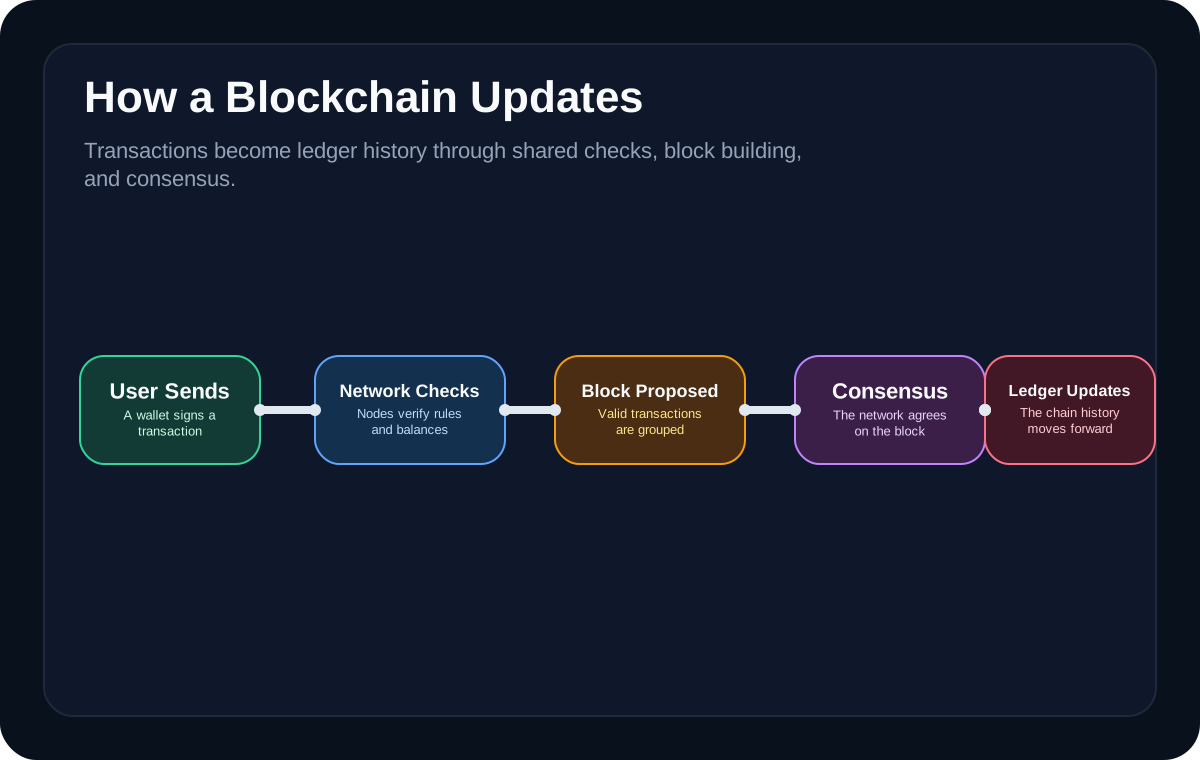
When someone sends crypto, the transaction is broadcast to the network and checked against the chain’s rules. Valid transactions are grouped into a block, and that block is then proposed and confirmed by miners or validators depending on the blockchain. Why this matters: the network is not just storing data, it is deciding which new data counts as real.
The real value of **how a transaction becomes part of a block** is that it explains what is happening behind the button a beginner clicks. Whether someone is *using ETH to pay for a smart-contract action on Ethereum* or *holding stablecoins in a wallet before moving into an exchange or DeFi app*, the outcome depends on a chain of infrastructure choices such as custody, routing, execution, and final settlement. Once that chain is clear, the topic stops feeling like crypto magic and starts feeling like a system with understandable moving parts.
Most people do not get hurt by the concept itself. They get hurt by the shortcuts they take around it. *Sending assets on the wrong network* can turn a simple workflow into an expensive mistake, and *chasing price action before understanding custody, gas fees, and confirmations* often becomes visible only after funds are already in motion. That is why good crypto education pairs the mechanics with practical failure modes instead of teaching the upside in isolation.
Beginners usually retain this faster when they attach it to a concrete decision rather than a glossary term. In practice, the concept becomes easier to trust and easier to question once you connect it to a workflow like *using ETH to pay for a smart-contract action on Ethereum* and ask what could break, slow down, or become expensive at each step.
**Why this matters:** How Blockchains Work is more useful when you can connect it to What Is Cryptocurrency, Buying Your First Crypto, and Ethereum & Smart Contracts. That broader map helps beginners judge when the tool fits, when a simpler path is safer, and which follow-on topic to study next before committing real money or signing real transactions.
Blocks, hashes, and linked history
Each block includes a cryptographic fingerprint called a hash, plus a reference to the block before it. That link creates an ordered chain of history, so changing old data would force an attacker to rewrite the linked records that come after it. What this means: blockchains are designed so history is easy to check and very hard to secretly rewrite.
**How Blockchains Work** becomes easier to understand when you translate it into a user flow instead of a definition. In practice, learners usually meet this idea while *holding stablecoins in a wallet before moving into an exchange or DeFi app*, then discover that the visible app action sits on top of wallet permissions, network rules, liquidity, or settlement assumptions that are easy to miss the first time. That is why the safest beginner habit is to ask how the action works, what the hidden dependency is, and what part of the system would fail first under stress.
Most people do not get hurt by the concept itself. They get hurt by the shortcuts they take around it. *Chasing price action before understanding custody, gas fees, and confirmations* can turn a simple workflow into an expensive mistake, and *confusing the wallet interface with the blockchain underneath it* often becomes visible only after funds are already in motion. That is why good crypto education pairs the mechanics with practical failure modes instead of teaching the upside in isolation.
A useful way to test whether this idea is landing is to picture where it shows up in a real workflow. Someone might run into it while *holding stablecoins in a wallet before moving into an exchange or DeFi app* or *sending BTC from one self-custody wallet to another*, which is why the topic matters most once money, permissions, or liquidity are already in motion instead of while reading definitions in the abstract.
**Why this matters:** How Blockchains Work is more useful when you can connect it to What Is Cryptocurrency, Buying Your First Crypto, and Ethereum & Smart Contracts. That broader map helps beginners judge when the tool fits, when a simpler path is safer, and which follow-on topic to study next before committing real money or signing real transactions.
Nodes and validators
Nodes store blockchain data and help relay information across the network. Validators or miners do the specialized work of helping the chain agree on the next valid block. Some nodes only observe and relay, while others play a direct role in consensus. In simple terms: nodes keep the network connected, and validators help move the ledger forward.
The real value of **nodes and validators** is that it explains what is happening behind the button a beginner clicks. Whether someone is *sending BTC from one self-custody wallet to another* or *using ETH to pay for a smart-contract action on Ethereum*, the outcome depends on a chain of infrastructure choices such as custody, routing, execution, and final settlement. Once that chain is clear, the topic stops feeling like crypto magic and starts feeling like a system with understandable moving parts.
A common beginner mistake here is *confusing the wallet interface with the blockchain underneath it*. Another is *sending assets on the wrong network*. Those errors usually do not come from bad intent; they come from skipping one layer of understanding and moving straight to the transaction. What can go wrong depends on the lesson, but the pattern is consistent: users either trust the wrong tool, underestimate timing and fees, or assume one network's rules apply everywhere. Slowing down long enough to verify the route, asset, counterparty, or contract address prevents a surprising share of early losses.
Beginners usually retain this faster when they attach it to a concrete decision rather than a glossary term. In practice, the concept becomes easier to trust and easier to question once you connect it to a workflow like *sending BTC from one self-custody wallet to another* and ask what could break, slow down, or become expensive at each step.
**Why this matters:** How Blockchains Work is more useful when you can connect it to What Is Cryptocurrency, Buying Your First Crypto, and Ethereum & Smart Contracts. That broader map helps beginners judge when the tool fits, when a simpler path is safer, and which follow-on topic to study next before committing real money or signing real transactions.
What decentralization means in practice
Decentralization does not mean there is no coordination. It means control is spread across many independent participants rather than resting with one company or government database. The more distributed the network is, the harder it becomes for any one actor to change the rules or censor activity alone. Why this matters: decentralization is one of the main reasons blockchains can stay open and resilient.
**How Blockchains Work** becomes easier to understand when you translate it into a user flow instead of a definition. In practice, learners usually meet this idea while *using ETH to pay for a smart-contract action on Ethereum*, then discover that the visible app action sits on top of wallet permissions, network rules, liquidity, or settlement assumptions that are easy to miss the first time. That is why the safest beginner habit is to ask how the action works, what the hidden dependency is, and what part of the system would fail first under stress.
Most people do not get hurt by the concept itself. They get hurt by the shortcuts they take around it. *Sending assets on the wrong network* can turn a simple workflow into an expensive mistake, and *chasing price action before understanding custody, gas fees, and confirmations* often becomes visible only after funds are already in motion. That is why good crypto education pairs the mechanics with practical failure modes instead of teaching the upside in isolation.
A useful way to test whether this idea is landing is to picture where it shows up in a real workflow. Someone might run into it while *using ETH to pay for a smart-contract action on Ethereum* or *holding stablecoins in a wallet before moving into an exchange or DeFi app*, which is why the topic matters most once money, permissions, or liquidity are already in motion instead of while reading definitions in the abstract.
**Why this matters:** How Blockchains Work is more useful when you can connect it to What Is Cryptocurrency, Buying Your First Crypto, and Ethereum & Smart Contracts. That broader map helps beginners judge when the tool fits, when a simpler path is safer, and which follow-on topic to study next before committing real money or signing real transactions.
Why blockchains are hard to tamper with
Changing blockchain history is difficult because it means beating the network’s consensus system and replacing records across many participants at the same time. On strong networks, that attack becomes expensive, visible, or both. What this means: security comes from incentives, coordination, and cryptography working together rather than from one hidden master server.
The real value of **why blockchains are hard to tamper with** is that it explains what is happening behind the button a beginner clicks. Whether someone is *holding stablecoins in a wallet before moving into an exchange or DeFi app* or *sending BTC from one self-custody wallet to another*, the outcome depends on a chain of infrastructure choices such as custody, routing, execution, and final settlement. Once that chain is clear, the topic stops feeling like crypto magic and starts feeling like a system with understandable moving parts.
Most people do not get hurt by the concept itself. They get hurt by the shortcuts they take around it. *Chasing price action before understanding custody, gas fees, and confirmations* can turn a simple workflow into an expensive mistake, and *confusing the wallet interface with the blockchain underneath it* often becomes visible only after funds are already in motion. That is why good crypto education pairs the mechanics with practical failure modes instead of teaching the upside in isolation.
Beginners usually retain this faster when they attach it to a concrete decision rather than a glossary term. In practice, the concept becomes easier to trust and easier to question once you connect it to a workflow like *holding stablecoins in a wallet before moving into an exchange or DeFi app* and ask what could break, slow down, or become expensive at each step.
**Why this matters:** How Blockchains Work is more useful when you can connect it to What Is Cryptocurrency, Buying Your First Crypto, and Ethereum & Smart Contracts. That broader map helps beginners judge when the tool fits, when a simpler path is safer, and which follow-on topic to study next before committing real money or signing real transactions.
- A user broadcasts a transaction to the network.
- Nodes share the transaction and check that it follows the rules.
- Validators or miners group valid transactions into a proposed block.
- The network agrees on the next valid block through its consensus system.
- The confirmed block becomes part of the chain’s shared history.
Visual Guides
Glossary
- Block
- A batch of confirmed transactions added to blockchain history.
- Hash
- A cryptographic fingerprint used to verify data integrity.
- Node
- A computer that stores blockchain data and shares it with the network.
- Validator
- A participant that helps confirm transactions and add valid blocks on proof-of-stake chains.
- Consensus
- The process a network uses to agree on which new blocks are valid.
FAQ
Is a blockchain just another kind of database?
Yes, but it is a special kind of shared database with a consensus system and linked block history. Its design focuses on verifiability, resilience, and shared rules across many participants.
What is the role of a node?
A node stores blockchain data and helps relay information across the network. Some nodes only observe, while others also validate or help produce blocks.
Why are blocks linked together?
They are linked through hashes so the network can verify the order and integrity of the chain’s history. That makes unauthorized edits easier to detect and harder to carry out.
Do all blockchains work exactly the same way?
No. Different chains use different consensus systems, block times, fee models, and scaling approaches. The core idea of shared verification stays, but the mechanics vary.
What makes a blockchain decentralized?
A blockchain is more decentralized when many independent participants can verify data, run nodes, and help enforce the rules. Concentrated control reduces that benefit even if the chain still uses blockchain technology.