Advanced Crypto
Tokenomics
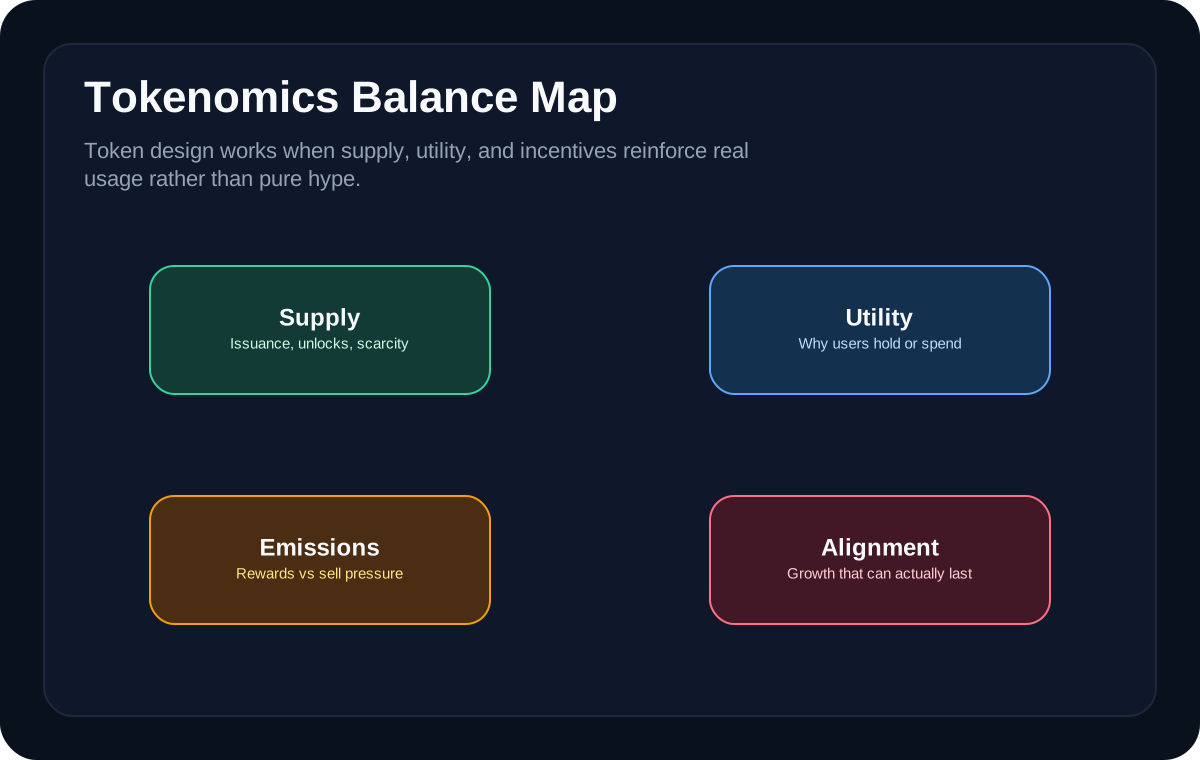
Tokenomics describes how a crypto asset’s supply, emissions, utility, and incentives are designed, and those choices heavily influence adoption, sell pressure, and long-term network alignment. It helps readers connect supply models and inflation vs deflation tokens while keeping the core tradeoffs and risks in view. Incentive mechanisms shape user behavior by rewarding actions like staking, providing liquidity, securing the network, or participating in governance.
TL;DR
Analyze supply design, emissions, incentives, and how token structures influence adoption, user behavior, and long-term market pressure. It clarifies supply models, inflation vs deflation tokens, and token utility design so the lesson fits into the bigger advanced crypto picture.
Supply models
A token's supply model defines how many units exist today, how many may exist in the future, and how issuance changes over time. Supply design affects scarcity, investor expectations, and how value is distributed across a network's life cycle. The important point is that supply is not just a number on a dashboard. It influences narrative, unlock pressure, validator incentives, treasury planning, and how much future dilution holders should expect. Tokenomics starts with supply because supply quietly shapes almost every downstream behavior.
**Tokenomics** becomes easier to understand when you translate it into a user flow instead of a definition. In practice, learners usually meet this idea while *comparing Ethereum mainnet congestion with lower-cost activity on rollups*, then discover that the visible app action sits on top of wallet permissions, network rules, liquidity, or settlement assumptions that are easy to miss the first time. That is why the safest beginner habit is to ask how the action works, what the hidden dependency is, and what part of the system would fail first under stress.
A common beginner mistake here is *memorizing jargon without mapping the tradeoff underneath it*. Another is *assuming the most decentralized design is always the most usable design*. Those errors usually do not come from bad intent; they come from skipping one layer of understanding and moving straight to the transaction. What can go wrong depends on the lesson, but the pattern is consistent: users either trust the wrong tool, underestimate timing and fees, or assume one network's rules apply everywhere. Slowing down long enough to verify the route, asset, counterparty, or contract address prevents a surprising share of early losses.
A useful way to test whether this idea is landing is to picture where it shows up in a real workflow. Someone might run into it while *comparing Ethereum mainnet congestion with lower-cost activity on rollups* or *reading token incentives to understand why a protocol can grow fast and still break later*, which is why the topic matters most once money, permissions, or liquidity are already in motion instead of while reading definitions in the abstract.
**Why this matters:** Tokenomics is more useful when you can connect it to Consensus Mechanisms, Crypto Market Cycles, and DeFi. That broader map helps beginners judge when the tool fits, when a simpler path is safer, and which follow-on topic to study next before committing real money or signing real transactions.
For primary-source context, see [Bitcoin white paper](https://bitcoin.org/en/bitcoin-paper), [Ethereum token standards](https://ethereum.org/developers/docs/standards/tokens/), and [Ethereum stablecoins guide](https://ethereum.org/en/stablecoins/).
Inflation vs deflation tokens
Inflationary tokens increase supply over time, often to reward validators, users, or ecosystem participants. Deflationary mechanisms reduce or offset supply growth through burns or limited issuance, but they only create durable value when they support real demand and utility. This is where marketing often gets ahead of substance. Calling a token deflationary does not automatically make it healthy, just as inflation does not automatically make it weak. The real question is whether issuance and reduction mechanisms reinforce the product or simply create short-term optics for traders.
The real value of **inflation vs deflation tokens** is that it explains what is happening behind the button a beginner clicks. Whether someone is *reading token incentives to understand why a protocol can grow fast and still break later* or *using on-chain data, liquidity conditions, and narrative shifts together instead of in isolation*, the outcome depends on a chain of infrastructure choices such as custody, routing, execution, and final settlement. Once that chain is clear, the topic stops feeling like crypto magic and starts feeling like a system with understandable moving parts.
Most people do not get hurt by the concept itself. They get hurt by the shortcuts they take around it. *Assuming the most decentralized design is always the most usable design* can turn a simple workflow into an expensive mistake, and *reading a single metric as if it explains the whole market* often becomes visible only after funds are already in motion. That is why good crypto education pairs the mechanics with practical failure modes instead of teaching the upside in isolation.
Beginners usually retain this faster when they attach it to a concrete decision rather than a glossary term. In practice, the concept becomes easier to trust and easier to question once you connect it to a workflow like *reading token incentives to understand why a protocol can grow fast and still break later* and ask what could break, slow down, or become expensive at each step.
**Why this matters:** Tokenomics is more useful when you can connect it to Consensus Mechanisms, Crypto Market Cycles, and DeFi. That broader map helps beginners judge when the tool fits, when a simpler path is safer, and which follow-on topic to study next before committing real money or signing real transactions.
Token utility design
Strong token utility gives users a clear reason to hold or use the asset beyond speculation. That utility might include governance, fee discounts, staking rights, access to products, collateral roles, or alignment between network growth and token demand. The strongest utility is usually tied to actual product behavior rather than abstract promises. If users must hold the token because it helps them do something meaningful inside the network, utility is more durable. If the token exists mainly to reward attention, utility often disappears when the incentives do.
**Tokenomics** becomes easier to understand when you translate it into a user flow instead of a definition. In practice, learners usually meet this idea while *using on-chain data, liquidity conditions, and narrative shifts together instead of in isolation*, then discover that the visible app action sits on top of wallet permissions, network rules, liquidity, or settlement assumptions that are easy to miss the first time. That is why the safest beginner habit is to ask how the action works, what the hidden dependency is, and what part of the system would fail first under stress.
Most people do not get hurt by the concept itself. They get hurt by the shortcuts they take around it. *Reading a single metric as if it explains the whole market* can turn a simple workflow into an expensive mistake, and *memorizing jargon without mapping the tradeoff underneath it* often becomes visible only after funds are already in motion. That is why good crypto education pairs the mechanics with practical failure modes instead of teaching the upside in isolation.
A useful way to test whether this idea is landing is to picture where it shows up in a real workflow. Someone might run into it while *using on-chain data, liquidity conditions, and narrative shifts together instead of in isolation* or *comparing Ethereum mainnet congestion with lower-cost activity on rollups*, which is why the topic matters most once money, permissions, or liquidity are already in motion instead of while reading definitions in the abstract.
**Why this matters:** Tokenomics is more useful when you can connect it to Consensus Mechanisms, Crypto Market Cycles, and DeFi. That broader map helps beginners judge when the tool fits, when a simpler path is safer, and which follow-on topic to study next before committing real money or signing real transactions.
Incentive mechanisms
Incentive mechanisms shape user behavior by rewarding actions like staking, providing liquidity, securing the network, or participating in governance. The hardest part of tokenomics is making short-term incentives attract users without creating long-term selling pressure or unsustainable dependence on emissions. This is where many otherwise strong products fail. Incentives can create early traction, but if users arrive only to extract rewards and leave, the token design may be funding temporary activity instead of lasting adoption. Good tokenomics tries to transition from reward-driven behavior to product-driven behavior over time.
The real value of **incentive mechanisms** is that it explains what is happening behind the button a beginner clicks. Whether someone is *comparing Ethereum mainnet congestion with lower-cost activity on rollups* or *reading token incentives to understand why a protocol can grow fast and still break later*, the outcome depends on a chain of infrastructure choices such as custody, routing, execution, and final settlement. Once that chain is clear, the topic stops feeling like crypto magic and starts feeling like a system with understandable moving parts.
A common beginner mistake here is *memorizing jargon without mapping the tradeoff underneath it*. Another is *assuming the most decentralized design is always the most usable design*. Those errors usually do not come from bad intent; they come from skipping one layer of understanding and moving straight to the transaction. What can go wrong depends on the lesson, but the pattern is consistent: users either trust the wrong tool, underestimate timing and fees, or assume one network's rules apply everywhere. Slowing down long enough to verify the route, asset, counterparty, or contract address prevents a surprising share of early losses.
Beginners usually retain this faster when they attach it to a concrete decision rather than a glossary term. In practice, the concept becomes easier to trust and easier to question once you connect it to a workflow like *comparing Ethereum mainnet congestion with lower-cost activity on rollups* and ask what could break, slow down, or become expensive at each step.
**Why this matters:** Tokenomics is more useful when you can connect it to Consensus Mechanisms, Crypto Market Cycles, and DeFi. That broader map helps beginners judge when the tool fits, when a simpler path is safer, and which follow-on topic to study next before committing real money or signing real transactions.
Why tokenomics can break otherwise good products
A product can have real users and still suffer if emissions overwhelm demand, unlock schedules hit too fast, or incentives train users to extract value rather than stay. Why this matters: token design often decides whether growth is durable or temporary.
**Tokenomics** becomes easier to understand when you translate it into a user flow instead of a definition. In practice, learners usually meet this idea while *reading token incentives to understand why a protocol can grow fast and still break later*, then discover that the visible app action sits on top of wallet permissions, network rules, liquidity, or settlement assumptions that are easy to miss the first time. That is why the safest beginner habit is to ask how the action works, what the hidden dependency is, and what part of the system would fail first under stress.
Most people do not get hurt by the concept itself. They get hurt by the shortcuts they take around it. *Assuming the most decentralized design is always the most usable design* can turn a simple workflow into an expensive mistake, and *reading a single metric as if it explains the whole market* often becomes visible only after funds are already in motion. That is why good crypto education pairs the mechanics with practical failure modes instead of teaching the upside in isolation.
A useful way to test whether this idea is landing is to picture where it shows up in a real workflow. Someone might run into it while *reading token incentives to understand why a protocol can grow fast and still break later* or *using on-chain data, liquidity conditions, and narrative shifts together instead of in isolation*, which is why the topic matters most once money, permissions, or liquidity are already in motion instead of while reading definitions in the abstract.
**Why this matters:** Tokenomics is more useful when you can connect it to Consensus Mechanisms, Crypto Market Cycles, and DeFi. That broader map helps beginners judge when the tool fits, when a simpler path is safer, and which follow-on topic to study next before committing real money or signing real transactions.
What better token design looks like
Better token design links supply, utility, and incentives to actions that actually strengthen the network or product. In simple terms: good tokenomics rewards behavior that creates lasting value, not just short-term attention.
The real value of **what better token design looks like** is that it explains what is happening behind the button a beginner clicks. Whether someone is *using on-chain data, liquidity conditions, and narrative shifts together instead of in isolation* or *comparing Ethereum mainnet congestion with lower-cost activity on rollups*, the outcome depends on a chain of infrastructure choices such as custody, routing, execution, and final settlement. Once that chain is clear, the topic stops feeling like crypto magic and starts feeling like a system with understandable moving parts.
Most people do not get hurt by the concept itself. They get hurt by the shortcuts they take around it. *Reading a single metric as if it explains the whole market* can turn a simple workflow into an expensive mistake, and *memorizing jargon without mapping the tradeoff underneath it* often becomes visible only after funds are already in motion. That is why good crypto education pairs the mechanics with practical failure modes instead of teaching the upside in isolation.
Beginners usually retain this faster when they attach it to a concrete decision rather than a glossary term. In practice, the concept becomes easier to trust and easier to question once you connect it to a workflow like *using on-chain data, liquidity conditions, and narrative shifts together instead of in isolation* and ask what could break, slow down, or become expensive at each step.
**Why this matters:** Tokenomics is more useful when you can connect it to Consensus Mechanisms, Crypto Market Cycles, and DeFi. That broader map helps beginners judge when the tool fits, when a simpler path is safer, and which follow-on topic to study next before committing real money or signing real transactions.
Visual Guides
Glossary
- Supply models
- A token's supply model defines how many units exist today, how many may exist in the future, and how issuance changes over time. Supply design affects scarcity, investor expectations, and how value is distributed across a network's life cycle.
- Inflation vs deflation tokens
- Inflationary tokens increase supply over time, often to reward validators, users, or ecosystem participants. Deflationary mechanisms reduce or offset supply growth through burns or limited issuance, but they only create durable value when they support real demand and utility.
- Token utility design
- Strong token utility gives users a clear reason to hold or use the asset beyond speculation. That utility might include governance, fee discounts, staking rights, access to products, collateral roles, or alignment between network growth and token demand.
- Incentive mechanisms
- Incentive mechanisms shape user behavior by rewarding actions like staking, providing liquidity, securing the network, or participating in governance. The hardest part of tokenomics is making short-term incentives attract users without creating long-term selling pressure or unsustainable dependence on emissions.
FAQ
What is tokenomics in simple terms?
Tokenomics describes how a crypto asset’s supply, emissions, utility, and incentives are designed, and those choices heavily influence adoption, sell pressure, and long-term network alignment.
Why does tokenomics matter in advanced crypto?
It matters because The important point is that supply is not just a number on a dashboard.
What should learners watch out for with tokenomics?
Watch for It influences narrative, unlock pressure, validator incentives, treasury planning, and how much future dilution holders should expect.
How does tokenomics connect to the rest of crypto?
It connects to Consensus Mechanisms, Crypto Market Cycles, DeFi. A token's supply model defines how many units exist today, how many may exist in the future, and how issuance changes over time.
What should I learn after tokenomics?
Next, study Consensus Mechanisms, Crypto Market Cycles, DeFi so you can connect this lesson to adjacent crypto concepts.