Advanced Crypto
Consensus Mechanisms
Consensus mechanisms are the rule systems blockchains use to agree on valid transactions and new blocks, and they shape the tradeoffs between security, decentralization, speed, and cost. It helps readers connect proof of work and proof of stake while keeping the core tradeoffs and risks in view. Its supporters value the link between security and physical resource expenditure, while critics focus on energy use, hardware concentration, and throughput limits.
TL;DR
Compare Proof of Work, Proof of Stake, and newer consensus designs and see how they change security, incentives, and validator power. It clarifies proof of work, proof of stake, and delegated pos so the lesson fits into the bigger advanced crypto picture.
Proof of Work
Proof of Work secures a blockchain by requiring miners to perform costly computational work before producing blocks. Its supporters value the link between security and physical resource expenditure, while critics focus on energy use, hardware concentration, and throughput limits. The important idea is that Proof of Work turns real-world cost into a defense mechanism. Attacking the chain requires enormous resource expenditure, which is part of why Bitcoin's security model is often described in physical rather than purely financial terms.
**Consensus Mechanisms** becomes easier to understand when you translate it into a user flow instead of a definition. In practice, learners usually meet this idea while *comparing Ethereum mainnet congestion with lower-cost activity on rollups*, then discover that the visible app action sits on top of wallet permissions, network rules, liquidity, or settlement assumptions that are easy to miss the first time. That is why the safest beginner habit is to ask how the action works, what the hidden dependency is, and what part of the system would fail first under stress.
A common beginner mistake here is *memorizing jargon without mapping the tradeoff underneath it*. Another is *assuming the most decentralized design is always the most usable design*. Those errors usually do not come from bad intent; they come from skipping one layer of understanding and moving straight to the transaction. What can go wrong depends on the lesson, but the pattern is consistent: users either trust the wrong tool, underestimate timing and fees, or assume one network's rules apply everywhere. Slowing down long enough to verify the route, asset, counterparty, or contract address prevents a surprising share of early losses.
A useful way to test whether this idea is landing is to picture where it shows up in a real workflow. Someone might run into it while *comparing Ethereum mainnet congestion with lower-cost activity on rollups* or *reading token incentives to understand why a protocol can grow fast and still break later*, which is why the topic matters most once money, permissions, or liquidity are already in motion instead of while reading definitions in the abstract.
**Why this matters:** Consensus Mechanisms is more useful when you can connect it to How Blockchains Work, What Is Cryptocurrency, and What Is Staking. That broader map helps beginners judge when the tool fits, when a simpler path is safer, and which follow-on topic to study next before committing real money or signing real transactions.
For primary-source context, see [Bitcoin developer guide](https://developer.bitcoin.org/), [Solana staking guide](https://solana.com/learn/what-is-staking), and [Ethereum smart contracts docs](https://ethereum.org/developers/docs/smart-contracts/).
Proof of Stake
Proof of Stake selects validators based on the assets they lock into the network rather than raw computing power. This can reduce energy costs and improve efficiency, but it also introduces design questions around slashing, validator concentration, and staking economics. The tradeoff is that economic stake becomes the core security input. That can make the system much lighter operationally, but it also means network safety depends heavily on validator incentives, delegation patterns, and whether stake becomes too concentrated in a few hands or services.
The real value of **proof of stake** is that it explains what is happening behind the button a beginner clicks. Whether someone is *reading token incentives to understand why a protocol can grow fast and still break later* or *using on-chain data, liquidity conditions, and narrative shifts together instead of in isolation*, the outcome depends on a chain of infrastructure choices such as custody, routing, execution, and final settlement. Once that chain is clear, the topic stops feeling like crypto magic and starts feeling like a system with understandable moving parts.
Most people do not get hurt by the concept itself. They get hurt by the shortcuts they take around it. *Assuming the most decentralized design is always the most usable design* can turn a simple workflow into an expensive mistake, and *reading a single metric as if it explains the whole market* often becomes visible only after funds are already in motion. That is why good crypto education pairs the mechanics with practical failure modes instead of teaching the upside in isolation.
Beginners usually retain this faster when they attach it to a concrete decision rather than a glossary term. In practice, the concept becomes easier to trust and easier to question once you connect it to a workflow like *reading token incentives to understand why a protocol can grow fast and still break later* and ask what could break, slow down, or become expensive at each step.
**Why this matters:** Consensus Mechanisms is more useful when you can connect it to How Blockchains Work, What Is Cryptocurrency, and What Is Staking. That broader map helps beginners judge when the tool fits, when a simpler path is safer, and which follow-on topic to study next before committing real money or signing real transactions.
Delegated PoS
Delegated Proof of Stake gives token holders the ability to vote for a smaller set of block producers. This can improve speed and coordination, although it often trades away some decentralization because a limited number of operators control validation. For users, that usually means faster chains and clearer operator sets, but also a more visible governance bottleneck. The design can work well for specific goals, yet it highlights the broader lesson of consensus: better performance usually comes from accepting some other compromise elsewhere.
**Consensus Mechanisms** becomes easier to understand when you translate it into a user flow instead of a definition. In practice, learners usually meet this idea while *using on-chain data, liquidity conditions, and narrative shifts together instead of in isolation*, then discover that the visible app action sits on top of wallet permissions, network rules, liquidity, or settlement assumptions that are easy to miss the first time. That is why the safest beginner habit is to ask how the action works, what the hidden dependency is, and what part of the system would fail first under stress.
Most people do not get hurt by the concept itself. They get hurt by the shortcuts they take around it. *Reading a single metric as if it explains the whole market* can turn a simple workflow into an expensive mistake, and *memorizing jargon without mapping the tradeoff underneath it* often becomes visible only after funds are already in motion. That is why good crypto education pairs the mechanics with practical failure modes instead of teaching the upside in isolation.
A useful way to test whether this idea is landing is to picture where it shows up in a real workflow. Someone might run into it while *using on-chain data, liquidity conditions, and narrative shifts together instead of in isolation* or *comparing Ethereum mainnet congestion with lower-cost activity on rollups*, which is why the topic matters most once money, permissions, or liquidity are already in motion instead of while reading definitions in the abstract.
**Why this matters:** Consensus Mechanisms is more useful when you can connect it to How Blockchains Work, What Is Cryptocurrency, and What Is Staking. That broader map helps beginners judge when the tool fits, when a simpler path is safer, and which follow-on topic to study next before committing real money or signing real transactions.
New consensus models
Newer consensus designs experiment with different mixes of speed, finality, security, and decentralization. Many modern chains combine staking, committee-based validation, sequencing layers, or modular settlement ideas to optimize for specific product goals rather than one universal model. That is why comparing consensus systems is really about comparing priorities. Some chains optimize for openness and neutrality, some for speed and app performance, and some for a middle ground. The better question is not which model sounds best in isolation, but which tradeoff profile the system is intentionally choosing.
The real value of **new consensus models** is that it explains what is happening behind the button a beginner clicks. Whether someone is *comparing Ethereum mainnet congestion with lower-cost activity on rollups* or *reading token incentives to understand why a protocol can grow fast and still break later*, the outcome depends on a chain of infrastructure choices such as custody, routing, execution, and final settlement. Once that chain is clear, the topic stops feeling like crypto magic and starts feeling like a system with understandable moving parts.
A common beginner mistake here is *memorizing jargon without mapping the tradeoff underneath it*. Another is *assuming the most decentralized design is always the most usable design*. Those errors usually do not come from bad intent; they come from skipping one layer of understanding and moving straight to the transaction. What can go wrong depends on the lesson, but the pattern is consistent: users either trust the wrong tool, underestimate timing and fees, or assume one network's rules apply everywhere. Slowing down long enough to verify the route, asset, counterparty, or contract address prevents a surprising share of early losses.
Beginners usually retain this faster when they attach it to a concrete decision rather than a glossary term. In practice, the concept becomes easier to trust and easier to question once you connect it to a workflow like *comparing Ethereum mainnet congestion with lower-cost activity on rollups* and ask what could break, slow down, or become expensive at each step.
**Why this matters:** Consensus Mechanisms is more useful when you can connect it to How Blockchains Work, What Is Cryptocurrency, and What Is Staking. That broader map helps beginners judge when the tool fits, when a simpler path is safer, and which follow-on topic to study next before committing real money or signing real transactions.
Why consensus is really about tradeoffs
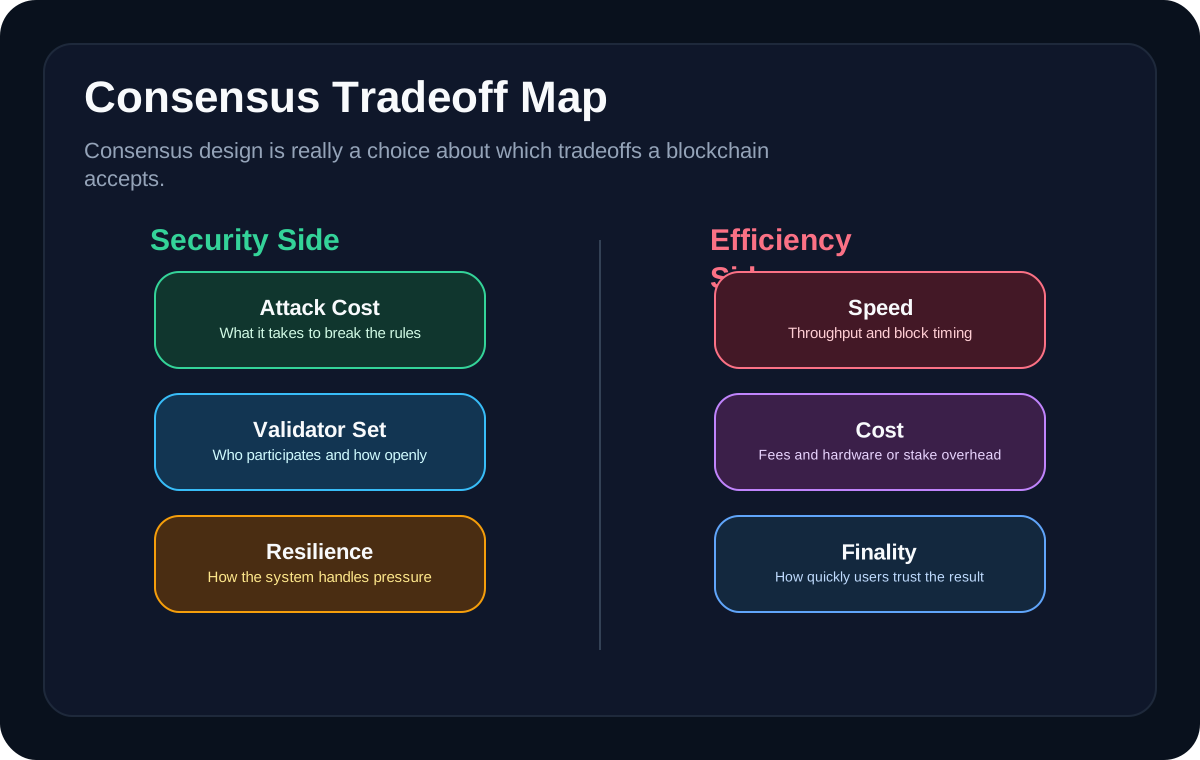
No consensus model wins on every axis at once. Every design shifts the balance between speed, openness, energy use, validator concentration, and how expensive it is to attack the network. Why this matters: consensus is where blockchain philosophy meets infrastructure reality.
**Consensus Mechanisms** becomes easier to understand when you translate it into a user flow instead of a definition. In practice, learners usually meet this idea while *reading token incentives to understand why a protocol can grow fast and still break later*, then discover that the visible app action sits on top of wallet permissions, network rules, liquidity, or settlement assumptions that are easy to miss the first time. That is why the safest beginner habit is to ask how the action works, what the hidden dependency is, and what part of the system would fail first under stress.
Most people do not get hurt by the concept itself. They get hurt by the shortcuts they take around it. *Assuming the most decentralized design is always the most usable design* can turn a simple workflow into an expensive mistake, and *reading a single metric as if it explains the whole market* often becomes visible only after funds are already in motion. That is why good crypto education pairs the mechanics with practical failure modes instead of teaching the upside in isolation.
A useful way to test whether this idea is landing is to picture where it shows up in a real workflow. Someone might run into it while *reading token incentives to understand why a protocol can grow fast and still break later* or *using on-chain data, liquidity conditions, and narrative shifts together instead of in isolation*, which is why the topic matters most once money, permissions, or liquidity are already in motion instead of while reading definitions in the abstract.
**Why this matters:** Consensus Mechanisms is more useful when you can connect it to How Blockchains Work, What Is Cryptocurrency, and What Is Staking. That broader map helps beginners judge when the tool fits, when a simpler path is safer, and which follow-on topic to study next before committing real money or signing real transactions.
What operators and users actually feel
Consensus affects block times, fees, finality, hardware needs, and how much trust users place in validator sets or governance. In simple terms: consensus is not abstract, it changes the day-to-day experience of using a chain.
The real value of **what operators and users actually feel** is that it explains what is happening behind the button a beginner clicks. Whether someone is *using on-chain data, liquidity conditions, and narrative shifts together instead of in isolation* or *comparing Ethereum mainnet congestion with lower-cost activity on rollups*, the outcome depends on a chain of infrastructure choices such as custody, routing, execution, and final settlement. Once that chain is clear, the topic stops feeling like crypto magic and starts feeling like a system with understandable moving parts.
Most people do not get hurt by the concept itself. They get hurt by the shortcuts they take around it. *Reading a single metric as if it explains the whole market* can turn a simple workflow into an expensive mistake, and *memorizing jargon without mapping the tradeoff underneath it* often becomes visible only after funds are already in motion. That is why good crypto education pairs the mechanics with practical failure modes instead of teaching the upside in isolation.
Beginners usually retain this faster when they attach it to a concrete decision rather than a glossary term. In practice, the concept becomes easier to trust and easier to question once you connect it to a workflow like *using on-chain data, liquidity conditions, and narrative shifts together instead of in isolation* and ask what could break, slow down, or become expensive at each step.
**Why this matters:** Consensus Mechanisms is more useful when you can connect it to How Blockchains Work, What Is Cryptocurrency, and What Is Staking. That broader map helps beginners judge when the tool fits, when a simpler path is safer, and which follow-on topic to study next before committing real money or signing real transactions.
Visual Guides
Glossary
- Proof of Work
- Proof of Work secures a blockchain by requiring miners to perform costly computational work before producing blocks. Its supporters value the link between security and physical resource expenditure, while critics focus on energy use, hardware concentration, and throughput limits.
- Proof of Stake
- Proof of Stake selects validators based on the assets they lock into the network rather than raw computing power. This can reduce energy costs and improve efficiency, but it also introduces design questions around slashing, validator concentration, and staking economics.
- Delegated PoS
- Delegated Proof of Stake gives token holders the ability to vote for a smaller set of block producers. This can improve speed and coordination, although it often trades away some decentralization because a limited number of operators control validation.
- New consensus models
- Newer consensus designs experiment with different mixes of speed, finality, security, and decentralization. Many modern chains combine staking, committee-based validation, sequencing layers, or modular settlement ideas to optimize for specific product goals rather than one universal model.
FAQ
What is consensus mechanisms in simple terms?
Consensus mechanisms are the rule systems blockchains use to agree on valid transactions and new blocks, and they shape the tradeoffs between security, decentralization, speed, and cost.
Why does consensus mechanisms matter in advanced crypto?
It matters because The important idea is that Proof of Work turns real-world cost into a defense mechanism.
What should learners watch out for with consensus mechanisms?
Watch for Its supporters value the link between security and physical resource expenditure, while critics focus on energy use, hardware concentration, and throughput limits.
How does consensus mechanisms connect to the rest of crypto?
It connects to How Blockchains Work, What Is Cryptocurrency, What Is Staking. Its supporters value the link between security and physical resource expenditure, while critics focus on energy use, hardware concentration, and throughput limits.
What should I learn after consensus mechanisms?
Next, study How Blockchains Work, What Is Cryptocurrency, What Is Staking so you can connect this lesson to adjacent crypto concepts.