Crypto Fundamentals
What Is Cryptocurrency
Cryptocurrency is a digital asset that runs on blockchain networks instead of bank databases. People use it to store value, move money online, access on-chain apps, and interact with internet-native financial systems using wallets, network rules, and cryptographic verification. It helps readers connect what cryptocurrency is and what it is not and why cryptocurrency was created while keeping the core tradeoffs and risks in view. For some users that matters because of censorship resistance, 24/7 markets, or self-custody.
TL;DR
Learn what cryptocurrency is, how it works, why it exists, what it is used for, and the tradeoffs beginners should understand before buying or storing any digital asset. It clarifies what cryptocurrency is and what it is not, why cryptocurrency was created, and how cryptocurrency works from wallet to blockchain so the lesson fits into the bigger crypto fundamentals picture.
What cryptocurrency is and what it is not
Cryptocurrency is internet-native value recorded on a blockchain instead of inside a bank database. The clearest beginner definition is this: crypto is a digital asset that can be stored in a wallet, transferred across a network, and verified by software rules rather than by a single financial institution. What cryptocurrency is not is just as important. It is not the same as dollars displayed in a banking app, it is not automatically anonymous, and it is not one single product category. Some crypto assets act more like money, some help run blockchain systems, and some mainly exist inside app ecosystems. If you want the system underneath that definition, the best next step is to [learn how blockchains work](/learn/crypto-fundamentals/how-blockchains-work).
**What Is Cryptocurrency** becomes easier to understand when you translate it into a user flow instead of a definition. In practice, learners usually meet this idea while *sending BTC from one self-custody wallet to another*, then discover that the visible app action sits on top of wallet permissions, network rules, liquidity, or settlement assumptions that are easy to miss the first time. That is why the safest beginner habit is to ask how the action works, what the hidden dependency is, and what part of the system would fail first under stress.
A common beginner mistake here is *confusing the wallet interface with the blockchain underneath it*. Another is *sending assets on the wrong network*. Those errors usually do not come from bad intent; they come from skipping one layer of understanding and moving straight to the transaction. What can go wrong depends on the lesson, but the pattern is consistent: users either trust the wrong tool, underestimate timing and fees, or assume one network's rules apply everywhere. Slowing down long enough to verify the route, asset, counterparty, or contract address prevents a surprising share of early losses.
A useful way to test whether this idea is landing is to picture where it shows up in a real workflow. Someone might run into it while *sending BTC from one self-custody wallet to another* or *using ETH to pay for a smart-contract action on Ethereum*, which is why the topic matters most once money, permissions, or liquidity are already in motion instead of while reading definitions in the abstract.
**Why this matters:** What Is Cryptocurrency is more useful when you can connect it to Browse the learn hub, Learn how blockchains work, and Understand crypto wallets and self-custody. That broader map helps beginners judge when the tool fits, when a simpler path is safer, and which follow-on topic to study next before committing real money or signing real transactions.
For primary-source context, see [Bitcoin white paper](https://bitcoin.org/en/bitcoin-paper), [Bitcoin developer guide](https://developer.bitcoin.org/), and [Ethereum wallets guide](https://ethereum.org/en/wallets).
Why cryptocurrency was created
Traditional online payments feel digital on the surface, but behind the scenes they still depend on banks, processors, permissions, settlement windows, and country-specific financial rails. Cryptocurrency exists because developers wanted a system where value could move more like information on the internet: globally, programmatically, and without every transaction requiring a familiar financial middleman. This does not mean crypto replaces every bank function or that it automatically improves every payment experience. It means crypto offers a different settlement model. For some users that matters because of censorship resistance, 24/7 markets, or self-custody. For others it matters because crypto unlocks new systems such as [DeFi](/learn/crypto-applications/decentralized-finance-defi), stablecoins, and programmable on-chain apps.
The real value of **why cryptocurrency was created** is that it explains what is happening behind the button a beginner clicks. Whether someone is *using ETH to pay for a smart-contract action on Ethereum* or *holding stablecoins in a wallet before moving into an exchange or DeFi app*, the outcome depends on a chain of infrastructure choices such as custody, routing, execution, and final settlement. Once that chain is clear, the topic stops feeling like crypto magic and starts feeling like a system with understandable moving parts.
Most people do not get hurt by the concept itself. They get hurt by the shortcuts they take around it. *Sending assets on the wrong network* can turn a simple workflow into an expensive mistake, and *chasing price action before understanding custody, gas fees, and confirmations* often becomes visible only after funds are already in motion. That is why good crypto education pairs the mechanics with practical failure modes instead of teaching the upside in isolation.
Beginners usually retain this faster when they attach it to a concrete decision rather than a glossary term. In practice, the concept becomes easier to trust and easier to question once you connect it to a workflow like *using ETH to pay for a smart-contract action on Ethereum* and ask what could break, slow down, or become expensive at each step.
**Why this matters:** What Is Cryptocurrency is more useful when you can connect it to Browse the learn hub, Learn how blockchains work, and Understand crypto wallets and self-custody. That broader map helps beginners judge when the tool fits, when a simpler path is safer, and which follow-on topic to study next before committing real money or signing real transactions.
- It gives users a way to hold assets outside traditional banking interfaces.
- It makes global transfer and settlement possible on shared internet infrastructure.
- It enables programmable assets and applications that run directly on-chain.
- It creates open networks where transaction history and rules can often be inspected publicly.
How cryptocurrency works from wallet to blockchain
A simple crypto transaction starts with a wallet. The wallet does not physically hold coins the way a leather wallet holds cash. Instead, it manages the keys that let you prove control over assets recorded on a blockchain. When you send crypto, your wallet signs a transaction, the network checks whether it follows the rules, and validators or miners add it to the ledger. That flow is why concepts such as wallet security, fees, confirmations, and network choice matter so much. If you use the wrong network or approve the wrong transaction, there is usually no customer-support team that can reverse it for you. That is also why beginners should pair this lesson with [crypto wallets](/learn/crypto-fundamentals/crypto-wallets) before moving funds around.
**What Is Cryptocurrency** becomes easier to understand when you translate it into a user flow instead of a definition. In practice, learners usually meet this idea while *holding stablecoins in a wallet before moving into an exchange or DeFi app*, then discover that the visible app action sits on top of wallet permissions, network rules, liquidity, or settlement assumptions that are easy to miss the first time. That is why the safest beginner habit is to ask how the action works, what the hidden dependency is, and what part of the system would fail first under stress.
Most people do not get hurt by the concept itself. They get hurt by the shortcuts they take around it. *Chasing price action before understanding custody, gas fees, and confirmations* can turn a simple workflow into an expensive mistake, and *confusing the wallet interface with the blockchain underneath it* often becomes visible only after funds are already in motion. That is why good crypto education pairs the mechanics with practical failure modes instead of teaching the upside in isolation.
A useful way to test whether this idea is landing is to picture where it shows up in a real workflow. Someone might run into it while *holding stablecoins in a wallet before moving into an exchange or DeFi app* or *sending BTC from one self-custody wallet to another*, which is why the topic matters most once money, permissions, or liquidity are already in motion instead of while reading definitions in the abstract.
**Why this matters:** What Is Cryptocurrency is more useful when you can connect it to Browse the learn hub, Learn how blockchains work, and Understand crypto wallets and self-custody. That broader map helps beginners judge when the tool fits, when a simpler path is safer, and which follow-on topic to study next before committing real money or signing real transactions.
- You open a wallet and select the asset and network you want to use.
- The wallet signs a transaction using the private key or secure signing method tied to your account.
- The blockchain network validates the transaction according to its own rules.
- The ledger updates, and the recipient can verify the transfer on-chain.
The main types of cryptocurrency beginners see first
Not every cryptocurrency does the same job. Coins are native to their own networks, like BTC on Bitcoin or ETH on Ethereum. Tokens are created on top of existing blockchains, often inside smart-contract ecosystems. Stablecoins are tokens designed to track the value of something more stable, usually the US dollar. This distinction matters because people often search for "what is cryptocurrency" when they really mean "what kind of crypto asset am I looking at?" Bitcoin is mainly discussed as a scarce digital asset and settlement network. Ether is tied to activity on Ethereum. Stablecoins are often used for transfers, trading pairs, and payments. If you later explore [how blockchains work](/learn/crypto-fundamentals/how-blockchains-work) or [buying your first crypto](/learn/crypto-fundamentals/buying-your-first-crypto), you will see why this category difference changes risk, fees, and user experience.
The real value of **the main types of cryptocurrency beginners see first** is that it explains what is happening behind the button a beginner clicks. Whether someone is *sending BTC from one self-custody wallet to another* or *using ETH to pay for a smart-contract action on Ethereum*, the outcome depends on a chain of infrastructure choices such as custody, routing, execution, and final settlement. Once that chain is clear, the topic stops feeling like crypto magic and starts feeling like a system with understandable moving parts.
A common beginner mistake here is *confusing the wallet interface with the blockchain underneath it*. Another is *sending assets on the wrong network*. Those errors usually do not come from bad intent; they come from skipping one layer of understanding and moving straight to the transaction. What can go wrong depends on the lesson, but the pattern is consistent: users either trust the wrong tool, underestimate timing and fees, or assume one network's rules apply everywhere. Slowing down long enough to verify the route, asset, counterparty, or contract address prevents a surprising share of early losses.
Beginners usually retain this faster when they attach it to a concrete decision rather than a glossary term. In practice, the concept becomes easier to trust and easier to question once you connect it to a workflow like *sending BTC from one self-custody wallet to another* and ask what could break, slow down, or become expensive at each step.
**Why this matters:** What Is Cryptocurrency is more useful when you can connect it to Browse the learn hub, Learn how blockchains work, and Understand crypto wallets and self-custody. That broader map helps beginners judge when the tool fits, when a simpler path is safer, and which follow-on topic to study next before committing real money or signing real transactions.
Visual Guides
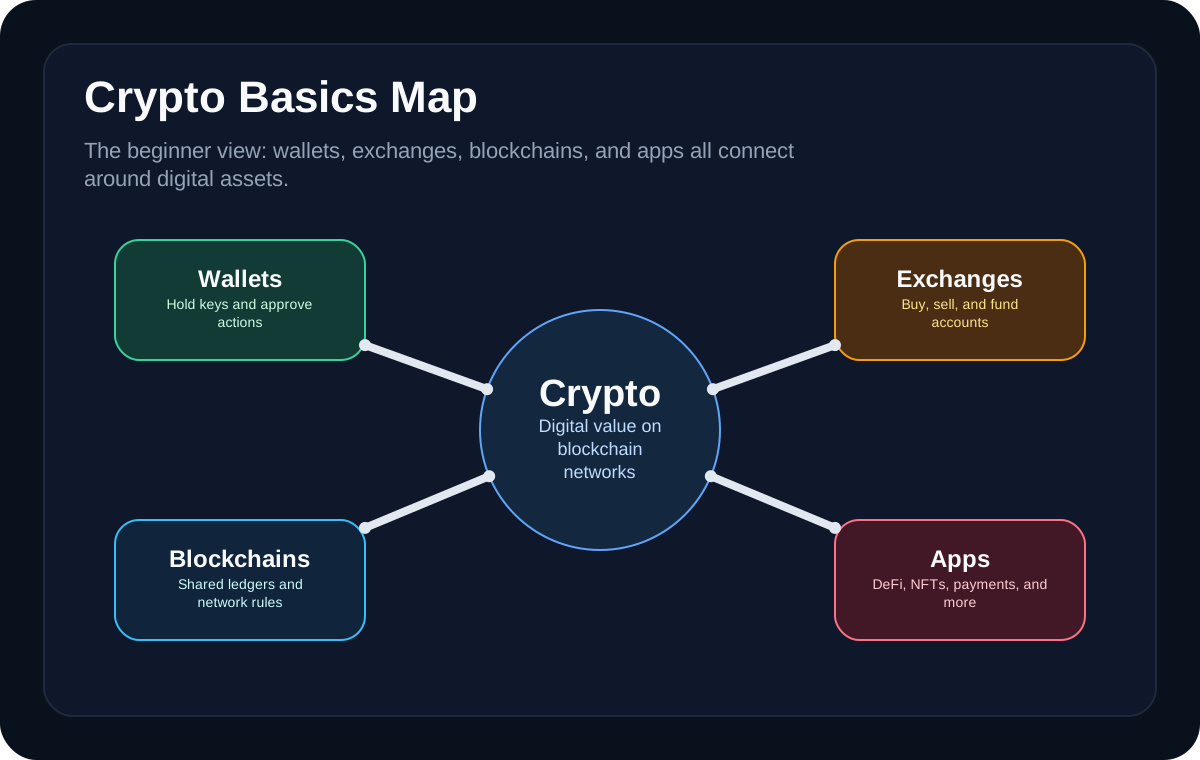
How people actually use crypto
The biggest beginner mistake is assuming crypto is only for investing. In practice, people use it for multiple jobs: long-term holding, trading, moving stablecoins between exchanges, accessing decentralized apps, collecting digital assets, and experimenting with on-chain financial tools. The actual use case depends on the asset, the blockchain, and the user's goal. For example, someone may use Bitcoin as a long-term store-of-value bet, use stablecoins to move dollars between platforms, and use ETH to pay network fees inside Ethereum apps. The same user might also use a tool like a [crypto DCA calculator](/tools/crypto-dca-calculator) to model recurring purchases while reading [latest crypto news](/latest-news) to understand what is moving the market. This is the practical reality beginners usually want clarified next: you do not need to do all of these things. You only need to understand that cryptocurrency is a broad system. Different assets are built for different jobs, and your next step should match your use case rather than social-media hype.
**What Is Cryptocurrency** becomes easier to understand when you translate it into a user flow instead of a definition. In practice, learners usually meet this idea while *using ETH to pay for a smart-contract action on Ethereum*, then discover that the visible app action sits on top of wallet permissions, network rules, liquidity, or settlement assumptions that are easy to miss the first time. That is why the safest beginner habit is to ask how the action works, what the hidden dependency is, and what part of the system would fail first under stress.
Most people do not get hurt by the concept itself. They get hurt by the shortcuts they take around it. *Sending assets on the wrong network* can turn a simple workflow into an expensive mistake, and *chasing price action before understanding custody, gas fees, and confirmations* often becomes visible only after funds are already in motion. That is why good crypto education pairs the mechanics with practical failure modes instead of teaching the upside in isolation.
A useful way to test whether this idea is landing is to picture where it shows up in a real workflow. Someone might run into it while *using ETH to pay for a smart-contract action on Ethereum* or *holding stablecoins in a wallet before moving into an exchange or DeFi app*, which is why the topic matters most once money, permissions, or liquidity are already in motion instead of while reading definitions in the abstract.
**Why this matters:** What Is Cryptocurrency is more useful when you can connect it to Browse the learn hub, Learn how blockchains work, and Understand crypto wallets and self-custody. That broader map helps beginners judge when the tool fits, when a simpler path is safer, and which follow-on topic to study next before committing real money or signing real transactions.
- Holding major assets such as Bitcoin or Ether over long time horizons.
- Trading or reallocating capital between assets and stablecoins.
- Sending value across borders or between platforms without using a bank wire.
- Using on-chain apps for lending, swapping, staking, or other blockchain-native actions.
Is cryptocurrency safe and what are the main risks
Crypto is not automatically safe or unsafe. It is a toolset with tradeoffs. The technology can be secure at the network level while individual users still lose money through scams, leverage, poor custody, wallet mistakes, protocol failures, or buying assets they do not understand. That is why the better beginner question is not only "is crypto safe?" but "which layer of crypto risk am I taking?" Price volatility is one risk. Self-custody mistakes are another. Smart-contract exploits inside DeFi are different again. A good learning path separates those risks instead of treating crypto as one giant yes-or-no category.
The real value of **is cryptocurrency safe and what are the main risks** is that it explains what is happening behind the button a beginner clicks. Whether someone is *holding stablecoins in a wallet before moving into an exchange or DeFi app* or *sending BTC from one self-custody wallet to another*, the outcome depends on a chain of infrastructure choices such as custody, routing, execution, and final settlement. Once that chain is clear, the topic stops feeling like crypto magic and starts feeling like a system with understandable moving parts.
Most people do not get hurt by the concept itself. They get hurt by the shortcuts they take around it. *Chasing price action before understanding custody, gas fees, and confirmations* can turn a simple workflow into an expensive mistake, and *confusing the wallet interface with the blockchain underneath it* often becomes visible only after funds are already in motion. That is why good crypto education pairs the mechanics with practical failure modes instead of teaching the upside in isolation.
Beginners usually retain this faster when they attach it to a concrete decision rather than a glossary term. In practice, the concept becomes easier to trust and easier to question once you connect it to a workflow like *holding stablecoins in a wallet before moving into an exchange or DeFi app* and ask what could break, slow down, or become expensive at each step.
**Why this matters:** What Is Cryptocurrency is more useful when you can connect it to Browse the learn hub, Learn how blockchains work, and Understand crypto wallets and self-custody. That broader map helps beginners judge when the tool fits, when a simpler path is safer, and which follow-on topic to study next before committing real money or signing real transactions.
- Market risk: prices can move sharply and unpredictably.
- Custody risk: losing keys or exposing seed phrases can mean losing assets permanently.
- Protocol risk: apps and bridges can fail, be hacked, or behave unexpectedly.
- Behavioral risk: hype, FOMO, and copying strangers online often lead to poor decisions.
The best next steps after learning what cryptocurrency is
If your goal is to understand crypto without getting overwhelmed, start with the rails before the speculation. Learn what a wallet does, how networks differ, why fees exist, and how custody changes responsibility. Then move into asset selection, platform choice, and position sizing. In practice, that usually means reading foundational lessons in order, using small amounts for first transactions, and treating security habits as part of the product rather than extra homework. A strong path is to move from this page into [crypto wallets](/learn/crypto-fundamentals/crypto-wallets), then [buying your first crypto](/learn/crypto-fundamentals/buying-your-first-crypto), and then the broader [learn hub](/learn) for deeper topic clusters. That sequence matters because most beginner frustration comes from skipping steps. People often ask what crypto is, then immediately jump to which coin to buy. The safer route is to understand the system first, the tools second, and only then the market decisions that sit on top of them.
**What Is Cryptocurrency** becomes easier to understand when you translate it into a user flow instead of a definition. In practice, learners usually meet this idea while *sending BTC from one self-custody wallet to another*, then discover that the visible app action sits on top of wallet permissions, network rules, liquidity, or settlement assumptions that are easy to miss the first time. That is why the safest beginner habit is to ask how the action works, what the hidden dependency is, and what part of the system would fail first under stress.
A common beginner mistake here is *confusing the wallet interface with the blockchain underneath it*. Another is *sending assets on the wrong network*. Those errors usually do not come from bad intent; they come from skipping one layer of understanding and moving straight to the transaction. What can go wrong depends on the lesson, but the pattern is consistent: users either trust the wrong tool, underestimate timing and fees, or assume one network's rules apply everywhere. Slowing down long enough to verify the route, asset, counterparty, or contract address prevents a surprising share of early losses.
A useful way to test whether this idea is landing is to picture where it shows up in a real workflow. Someone might run into it while *sending BTC from one self-custody wallet to another* or *using ETH to pay for a smart-contract action on Ethereum*, which is why the topic matters most once money, permissions, or liquidity are already in motion instead of while reading definitions in the abstract.
**Why this matters:** What Is Cryptocurrency is more useful when you can connect it to Browse the learn hub, Learn how blockchains work, and Understand crypto wallets and self-custody. That broader map helps beginners judge when the tool fits, when a simpler path is safer, and which follow-on topic to study next before committing real money or signing real transactions.
- Start with foundational lessons such as blockchain basics and wallet safety.
- Use tiny test transactions before moving meaningful funds.
- Separate learning from speculation so price swings do not drive every decision.
- Build a habit of checking addresses, networks, permissions, and custody setup every time.
Glossary
- Blockchain
- A shared record of transactions that many computers can verify together.
- Wallet
- A tool that lets you control crypto assets and approve transactions.
- Coin
- A native asset that belongs to its own blockchain network.
- Token
- An asset created on top of an existing blockchain, often through a smart contract.
- Gas fee
- A network fee paid to process a blockchain transaction or smart-contract action.
FAQ
Is cryptocurrency the same as digital money in a bank app?
No. Bank app balances are still claims inside the banking system, while cryptocurrency balances are controlled through blockchain networks and wallet keys. Both are digital, but the infrastructure underneath them is very different.
Do you need a bank account to use crypto?
Not always. Many people first enter crypto through an exchange funded by a bank card or transfer, but crypto itself can be sent and received with only a wallet and an internet connection.
How does cryptocurrency actually work?
A wallet signs transactions, the blockchain network checks whether they follow the rules, and validators or miners update the ledger. The asset itself is recorded on-chain, while the wallet gives you control over the keys needed to use it.
What is the difference between a coin and a token?
A coin is native to its own blockchain, like BTC on Bitcoin. A token is issued on top of an existing blockchain, often through a smart contract. Stablecoins are a common token category designed for price stability.
Why do people say crypto gives users more control?
Because users can often hold assets in self-custody wallets and interact directly with networks instead of only through financial institutions. That added control also means users must manage security more carefully.
What is cryptocurrency used for besides investing?
People use crypto for transfers, stablecoin payments, on-chain applications, DeFi, trading, settlement between platforms, and experimenting with blockchain-based services. Investment is only one part of the broader category.
Is cryptocurrency safe for beginners?
It can be used safely, but beginners need to respect the risks. The biggest issues are usually scams, poor custody habits, rushed transactions, and buying assets or using apps without understanding how they work.
Is crypto only used for investing?
No. Crypto is also used for payments, remittances, stablecoins, DeFi apps, NFTs, on-chain gaming, and moving value across global internet-based services.
What should a beginner learn first?
Start with wallets, blockchains, fees, and security before diving into advanced apps or trading. Those basics make the rest of crypto much easier to understand.