Crypto Applications
Stablecoins
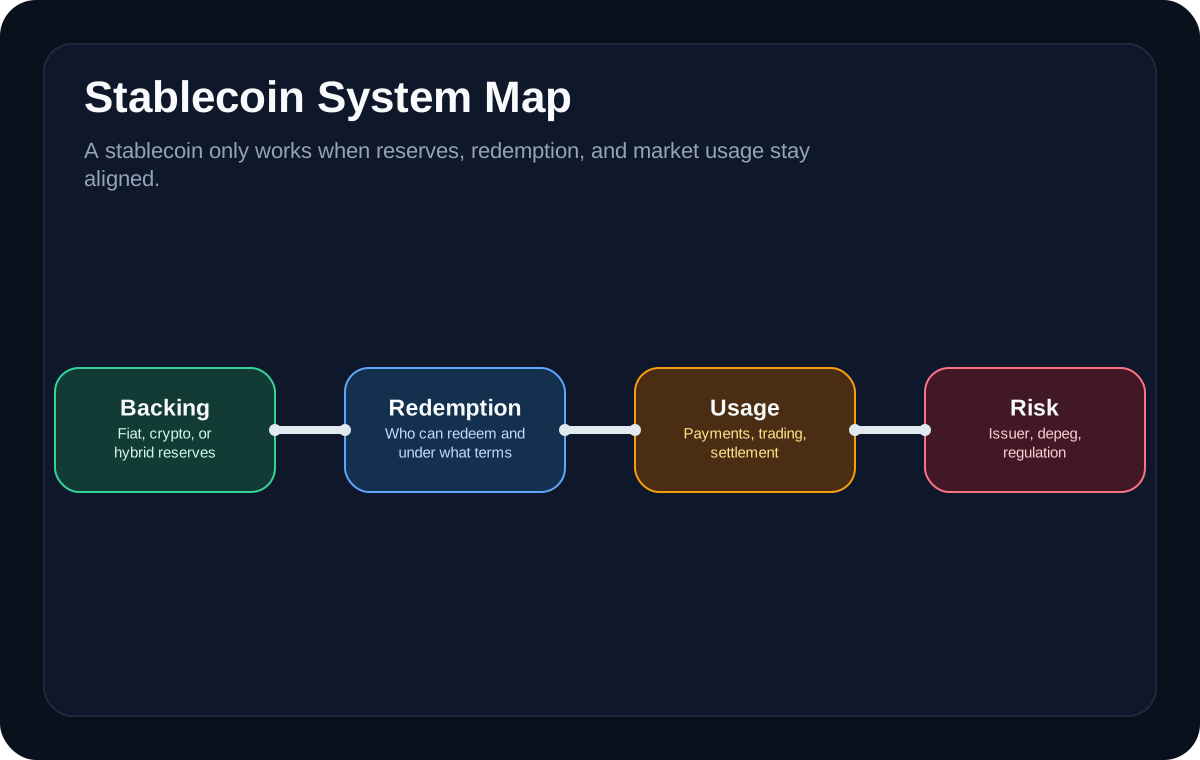
Stablecoins are crypto assets designed to track a stable price, usually the US dollar, and they now power trading, payments, remittances, DeFi collateral, and much of crypto’s day-to-day liquidity. It helps readers connect why stablecoins exist and fiat-backed vs algorithmic while keeping the core tradeoffs and risks in view. Each model offers a different tradeoff between transparency, decentralization, liquidity, redemption design, and regulatory dependence.
TL;DR
Study fiat-backed, crypto-backed, and newer stablecoin designs and why they matter for payments, trading, and crypto market structure. It clarifies why stablecoins exist, fiat-backed vs algorithmic, and usdt, usdc, dai explained so the lesson fits into the bigger crypto applications picture.
Why stablecoins exist
Stablecoins exist to give users a crypto-native asset that aims to keep a steady price, usually around one US dollar. They are widely used for trading, savings, payments, and moving value between platforms without fully exiting the crypto ecosystem. In practical terms, stablecoins act like the cash layer of crypto markets. They make it easier to park value, settle trades, post collateral, or send dollar-like funds through wallets and blockchain rails. That role is why they sit at the center of both [DeFi](/learn/crypto-applications/decentralized-finance-defi) and modern exchange activity.
**Stablecoins** becomes easier to understand when you translate it into a user flow instead of a definition. In practice, learners usually meet this idea while *swapping tokens in a decentralized exchange such as Uniswap*, then discover that the visible app action sits on top of wallet permissions, network rules, liquidity, or settlement assumptions that are easy to miss the first time. That is why the safest beginner habit is to ask how the action works, what the hidden dependency is, and what part of the system would fail first under stress.
A common beginner mistake here is *granting risky token approvals to the wrong contract*. Another is *assuming a popular app is automatically safe*. Those errors usually do not come from bad intent; they come from skipping one layer of understanding and moving straight to the transaction. What can go wrong depends on the lesson, but the pattern is consistent: users either trust the wrong tool, underestimate timing and fees, or assume one network's rules apply everywhere. Slowing down long enough to verify the route, asset, counterparty, or contract address prevents a surprising share of early losses.
A useful way to test whether this idea is landing is to picture where it shows up in a real workflow. Someone might run into it while *swapping tokens in a decentralized exchange such as Uniswap* or *posting stablecoins as collateral inside a lending app*, which is why the topic matters most once money, permissions, or liquidity are already in motion instead of while reading definitions in the abstract.
**Why this matters:** Stablecoins is more useful when you can connect it to DeFi, Crypto Security, and Crypto Trading Basics. That broader map helps beginners judge when the tool fits, when a simpler path is safer, and which follow-on topic to study next before committing real money or signing real transactions.
For primary-source context, see [Ethereum stablecoins guide](https://ethereum.org/en/stablecoins/), [Circle USDC overview](https://www.circle.com/usdc), and [USDC terms and reserves framing](https://www.circle.com/legal/usdc-terms).
Fiat-backed vs algorithmic
Fiat-backed stablecoins are supported by reserves like cash or short-term government securities, while algorithmic designs try to maintain their peg through code, incentives, or supply adjustments. The second model is generally more fragile because stability depends more heavily on confidence, reflexive demand, or market incentives than on straightforward collateral. For beginners, the key mental model is simple: a one-dollar target does not tell you how the peg is defended. Some systems rely on redeemable reserves, some rely on excess crypto collateral, and some rely on market behavior holding together under stress. Those are very different foundations even if the ticker looks equally stable in calm conditions.
The real value of **fiat-backed vs algorithmic** is that it explains what is happening behind the button a beginner clicks. Whether someone is *posting stablecoins as collateral inside a lending app* or *moving between an exchange, a wallet, and a crypto app without leaving blockchain rails*, the outcome depends on a chain of infrastructure choices such as custody, routing, execution, and final settlement. Once that chain is clear, the topic stops feeling like crypto magic and starts feeling like a system with understandable moving parts.
Most people do not get hurt by the concept itself. They get hurt by the shortcuts they take around it. *Assuming a popular app is automatically safe* can turn a simple workflow into an expensive mistake, and *treating yields, floor prices, or governance tokens as if they were risk-free* often becomes visible only after funds are already in motion. That is why good crypto education pairs the mechanics with practical failure modes instead of teaching the upside in isolation.
Beginners usually retain this faster when they attach it to a concrete decision rather than a glossary term. In practice, the concept becomes easier to trust and easier to question once you connect it to a workflow like *posting stablecoins as collateral inside a lending app* and ask what could break, slow down, or become expensive at each step.
**Why this matters:** Stablecoins is more useful when you can connect it to DeFi, Crypto Security, and Crypto Trading Basics. That broader map helps beginners judge when the tool fits, when a simpler path is safer, and which follow-on topic to study next before committing real money or signing real transactions.
USDT, USDC, DAI explained
USDT and USDC are major fiat-backed stablecoins issued by centralized organizations, while DAI is designed as a decentralized stablecoin backed by crypto collateral. Each model offers a different tradeoff between transparency, decentralization, liquidity, redemption design, and regulatory dependence. That is why these tokens should not be grouped together too casually. USDC may appeal to users who prioritize issuer clarity and reserve reporting, while DAI may appeal to users who value on-chain collateral logic more highly. The important lesson is that stablecoins are a category, not one uniform product.
**Stablecoins** becomes easier to understand when you translate it into a user flow instead of a definition. In practice, learners usually meet this idea while *moving between an exchange, a wallet, and a crypto app without leaving blockchain rails*, then discover that the visible app action sits on top of wallet permissions, network rules, liquidity, or settlement assumptions that are easy to miss the first time. That is why the safest beginner habit is to ask how the action works, what the hidden dependency is, and what part of the system would fail first under stress.
Most people do not get hurt by the concept itself. They get hurt by the shortcuts they take around it. *Treating yields, floor prices, or governance tokens as if they were risk-free* can turn a simple workflow into an expensive mistake, and *granting risky token approvals to the wrong contract* often becomes visible only after funds are already in motion. That is why good crypto education pairs the mechanics with practical failure modes instead of teaching the upside in isolation.
A useful way to test whether this idea is landing is to picture where it shows up in a real workflow. Someone might run into it while *moving between an exchange, a wallet, and a crypto app without leaving blockchain rails* or *swapping tokens in a decentralized exchange such as Uniswap*, which is why the topic matters most once money, permissions, or liquidity are already in motion instead of while reading definitions in the abstract.
**Why this matters:** Stablecoins is more useful when you can connect it to DeFi, Crypto Security, and Crypto Trading Basics. That broader map helps beginners judge when the tool fits, when a simpler path is safer, and which follow-on topic to study next before committing real money or signing real transactions.
Stablecoin risks
Stablecoins can face reserve risk, issuer risk, depegging risk, smart contract risk, liquidity stress, and regulatory pressure. Users should understand what backs a stablecoin, who can freeze or redeem it, and how that redemption actually works before treating it like a perfect substitute for cash. The simplest beginner mistake is assuming that price stability today means structural safety tomorrow. A stablecoin can trade close to one dollar for a long time and still break under stress if confidence, reserves, collateral quality, or redemption access start to fail at the wrong moment.
The real value of **stablecoin risks** is that it explains what is happening behind the button a beginner clicks. Whether someone is *swapping tokens in a decentralized exchange such as Uniswap* or *posting stablecoins as collateral inside a lending app*, the outcome depends on a chain of infrastructure choices such as custody, routing, execution, and final settlement. Once that chain is clear, the topic stops feeling like crypto magic and starts feeling like a system with understandable moving parts.
A common beginner mistake here is *granting risky token approvals to the wrong contract*. Another is *assuming a popular app is automatically safe*. Those errors usually do not come from bad intent; they come from skipping one layer of understanding and moving straight to the transaction. What can go wrong depends on the lesson, but the pattern is consistent: users either trust the wrong tool, underestimate timing and fees, or assume one network's rules apply everywhere. Slowing down long enough to verify the route, asset, counterparty, or contract address prevents a surprising share of early losses.
Beginners usually retain this faster when they attach it to a concrete decision rather than a glossary term. In practice, the concept becomes easier to trust and easier to question once you connect it to a workflow like *swapping tokens in a decentralized exchange such as Uniswap* and ask what could break, slow down, or become expensive at each step.
**Why this matters:** Stablecoins is more useful when you can connect it to DeFi, Crypto Security, and Crypto Trading Basics. That broader map helps beginners judge when the tool fits, when a simpler path is safer, and which follow-on topic to study next before committing real money or signing real transactions.
Why stablecoins matter for payments now
Stablecoins are increasingly used as internet-native settlement assets because they move faster than many traditional cross-border systems and can plug directly into crypto wallets and apps. In simple terms: stablecoins are becoming the cash layer for much of crypto activity.
**Stablecoins** becomes easier to understand when you translate it into a user flow instead of a definition. In practice, learners usually meet this idea while *posting stablecoins as collateral inside a lending app*, then discover that the visible app action sits on top of wallet permissions, network rules, liquidity, or settlement assumptions that are easy to miss the first time. That is why the safest beginner habit is to ask how the action works, what the hidden dependency is, and what part of the system would fail first under stress.
Most people do not get hurt by the concept itself. They get hurt by the shortcuts they take around it. *Assuming a popular app is automatically safe* can turn a simple workflow into an expensive mistake, and *treating yields, floor prices, or governance tokens as if they were risk-free* often becomes visible only after funds are already in motion. That is why good crypto education pairs the mechanics with practical failure modes instead of teaching the upside in isolation.
A useful way to test whether this idea is landing is to picture where it shows up in a real workflow. Someone might run into it while *posting stablecoins as collateral inside a lending app* or *moving between an exchange, a wallet, and a crypto app without leaving blockchain rails*, which is why the topic matters most once money, permissions, or liquidity are already in motion instead of while reading definitions in the abstract.
**Why this matters:** Stablecoins is more useful when you can connect it to DeFi, Crypto Security, and Crypto Trading Basics. That broader map helps beginners judge when the tool fits, when a simpler path is safer, and which follow-on topic to study next before committing real money or signing real transactions.
Issuer and regulatory risk
A stablecoin is only as durable as its reserves, legal structure, redemption process, and the rules around who can issue or freeze it. Why this matters: two stablecoins that both target one dollar can still carry very different levels of trust and control risk.
The real value of **issuer and regulatory risk** is that it explains what is happening behind the button a beginner clicks. Whether someone is *moving between an exchange, a wallet, and a crypto app without leaving blockchain rails* or *swapping tokens in a decentralized exchange such as Uniswap*, the outcome depends on a chain of infrastructure choices such as custody, routing, execution, and final settlement. Once that chain is clear, the topic stops feeling like crypto magic and starts feeling like a system with understandable moving parts.
Most people do not get hurt by the concept itself. They get hurt by the shortcuts they take around it. *Treating yields, floor prices, or governance tokens as if they were risk-free* can turn a simple workflow into an expensive mistake, and *granting risky token approvals to the wrong contract* often becomes visible only after funds are already in motion. That is why good crypto education pairs the mechanics with practical failure modes instead of teaching the upside in isolation.
Beginners usually retain this faster when they attach it to a concrete decision rather than a glossary term. In practice, the concept becomes easier to trust and easier to question once you connect it to a workflow like *moving between an exchange, a wallet, and a crypto app without leaving blockchain rails* and ask what could break, slow down, or become expensive at each step.
**Why this matters:** Stablecoins is more useful when you can connect it to DeFi, Crypto Security, and Crypto Trading Basics. That broader map helps beginners judge when the tool fits, when a simpler path is safer, and which follow-on topic to study next before committing real money or signing real transactions.
Visual Guides
Glossary
- Why stablecoins exist
- Stablecoins exist to give users a crypto-native asset that aims to keep a steady price, usually around one US dollar. They are widely used for trading, savings, payments, and moving value between platforms without fully exiting the crypto ecosystem.
- Fiat-backed vs algorithmic
- Fiat-backed stablecoins are supported by reserves like cash or short-term government securities, while algorithmic designs try to maintain their peg through code, incentives, or supply adjustments. The second model is generally more fragile because stability depends more heavily on confidence, reflexive demand, or market incentives than on straightforward collateral.
- USDT, USDC, DAI explained
- USDT and USDC are major fiat-backed stablecoins issued by centralized organizations, while DAI is designed as a decentralized stablecoin backed by crypto collateral. Each model offers a different tradeoff between transparency, decentralization, liquidity, redemption design, and regulatory dependence.
- Stablecoin risks
- Stablecoins can face reserve risk, issuer risk, depegging risk, smart contract risk, liquidity stress, and regulatory pressure. Users should understand what backs a stablecoin, who can freeze or redeem it, and how that redemption actually works before treating it like a perfect substitute for cash.
FAQ
What is stablecoins in simple terms?
Stablecoins are crypto assets designed to track a stable price, usually the US dollar, and they now power trading, payments, remittances, DeFi collateral, and much of crypto’s day-to-day liquidity.
Why does stablecoins matter in crypto applications?
It matters because The important lesson is that stablecoins are a category, not one uniform product.
What should learners watch out for with stablecoins?
Watch for Each model offers a different tradeoff between transparency, decentralization, liquidity, redemption design, and regulatory dependence.
How does stablecoins connect to the rest of crypto?
It connects to DeFi, Crypto Security, Crypto Trading Basics. They are widely used for trading, savings, payments, and moving value between platforms without fully exiting the crypto ecosystem.
What should I learn after stablecoins?
Next, study DeFi, Crypto Security, Crypto Trading Basics so you can connect this lesson to adjacent crypto concepts.