Crypto Applications
Decentralized Finance (DeFi)
DeFi is a set of blockchain-based financial apps that let users trade, lend, borrow, and earn yield directly from wallets through smart contracts rather than bank-controlled systems. It helps readers connect what defi is and lending and borrowing while keeping the core tradeoffs and risks in view. Users rely less on a bank branch and more on smart contract code, governance decisions, oracle systems, and the security of the blockchain underneath the app.
TL;DR
Learn how lending, borrowing, liquidity pools, and modern on-chain finance work across wallets, smart contracts, and tokenized markets. It clarifies what defi is, lending and borrowing, and liquidity pools so the lesson fits into the bigger crypto applications picture.
What DeFi is
DeFi refers to financial services built on blockchains through smart contracts rather than banks. Instead of opening an account with a traditional financial institution, users connect a wallet to an app and interact with software that enforces lending, trading, borrowing, or collateral rules on-chain. That does not mean DeFi removes trust completely. It changes where trust sits. Users rely less on a bank branch and more on smart contract code, governance decisions, oracle systems, and the security of the blockchain underneath the app. That is why DeFi makes more sense when paired with [Ethereum & Smart Contracts](/learn/crypto-fundamentals/ethereum-smart-contracts) and [Crypto Security](/learn/crypto-applications/crypto-security).
**Decentralized Finance (DeFi)** becomes easier to understand when you translate it into a user flow instead of a definition. In practice, learners usually meet this idea while *swapping tokens in a decentralized exchange such as Uniswap*, then discover that the visible app action sits on top of wallet permissions, network rules, liquidity, or settlement assumptions that are easy to miss the first time. That is why the safest beginner habit is to ask how the action works, what the hidden dependency is, and what part of the system would fail first under stress.
A common beginner mistake here is *granting risky token approvals to the wrong contract*. Another is *assuming a popular app is automatically safe*. Those errors usually do not come from bad intent; they come from skipping one layer of understanding and moving straight to the transaction. What can go wrong depends on the lesson, but the pattern is consistent: users either trust the wrong tool, underestimate timing and fees, or assume one network's rules apply everywhere. Slowing down long enough to verify the route, asset, counterparty, or contract address prevents a surprising share of early losses.
A useful way to test whether this idea is landing is to picture where it shows up in a real workflow. Someone might run into it while *swapping tokens in a decentralized exchange such as Uniswap* or *posting stablecoins as collateral inside a lending app*, which is why the topic matters most once money, permissions, or liquidity are already in motion instead of while reading definitions in the abstract.
**Why this matters:** Decentralized Finance (DeFi) is more useful when you can connect it to Ethereum & Smart Contracts, Stablecoins, and Crypto Security. That broader map helps beginners judge when the tool fits, when a simpler path is safer, and which follow-on topic to study next before committing real money or signing real transactions.
For primary-source context, see [Ethereum DeFi guide](https://ethereum.org/pcm/defi/), [Ethereum stablecoins guide](https://ethereum.org/en/stablecoins/), and [Ethereum smart contracts docs](https://ethereum.org/developers/docs/smart-contracts/).
Lending and borrowing
DeFi lending protocols let users deposit crypto to earn interest or borrow against their existing holdings. Borrowers usually post collateral first, and the protocol automatically manages loan rules such as liquidation thresholds, collateral ratios, and changing interest rates. The important shift is that the entire system runs continuously on-chain. If the value of collateral falls too far, the position can be liquidated automatically without a banker calling first. For beginners, that is the key difference: DeFi lending is open and programmable, but it is also less forgiving when markets move fast.
The real value of **lending and borrowing** is that it explains what is happening behind the button a beginner clicks. Whether someone is *posting stablecoins as collateral inside a lending app* or *moving between an exchange, a wallet, and a crypto app without leaving blockchain rails*, the outcome depends on a chain of infrastructure choices such as custody, routing, execution, and final settlement. Once that chain is clear, the topic stops feeling like crypto magic and starts feeling like a system with understandable moving parts.
Most people do not get hurt by the concept itself. They get hurt by the shortcuts they take around it. *Assuming a popular app is automatically safe* can turn a simple workflow into an expensive mistake, and *treating yields, floor prices, or governance tokens as if they were risk-free* often becomes visible only after funds are already in motion. That is why good crypto education pairs the mechanics with practical failure modes instead of teaching the upside in isolation.
Beginners usually retain this faster when they attach it to a concrete decision rather than a glossary term. In practice, the concept becomes easier to trust and easier to question once you connect it to a workflow like *posting stablecoins as collateral inside a lending app* and ask what could break, slow down, or become expensive at each step.
**Why this matters:** Decentralized Finance (DeFi) is more useful when you can connect it to Ethereum & Smart Contracts, Stablecoins, and Crypto Security. That broader map helps beginners judge when the tool fits, when a simpler path is safer, and which follow-on topic to study next before committing real money or signing real transactions.
Liquidity pools
Liquidity pools are collections of tokens locked into smart contracts so traders can swap assets without a traditional order book. Instead of matching one buyer with one seller, automated market maker systems use pooled assets and pricing formulas to keep trades flowing. People who supply assets to those pools help the market function and can earn a share of the trading fees, but they also take on risk. Pool positions can underperform simply holding the assets, especially when prices move sharply. That is why liquidity provision should be understood as a market-making role, not as effortless passive income.
**Decentralized Finance (DeFi)** becomes easier to understand when you translate it into a user flow instead of a definition. In practice, learners usually meet this idea while *moving between an exchange, a wallet, and a crypto app without leaving blockchain rails*, then discover that the visible app action sits on top of wallet permissions, network rules, liquidity, or settlement assumptions that are easy to miss the first time. That is why the safest beginner habit is to ask how the action works, what the hidden dependency is, and what part of the system would fail first under stress.
Most people do not get hurt by the concept itself. They get hurt by the shortcuts they take around it. *Treating yields, floor prices, or governance tokens as if they were risk-free* can turn a simple workflow into an expensive mistake, and *granting risky token approvals to the wrong contract* often becomes visible only after funds are already in motion. That is why good crypto education pairs the mechanics with practical failure modes instead of teaching the upside in isolation.
A useful way to test whether this idea is landing is to picture where it shows up in a real workflow. Someone might run into it while *moving between an exchange, a wallet, and a crypto app without leaving blockchain rails* or *swapping tokens in a decentralized exchange such as Uniswap*, which is why the topic matters most once money, permissions, or liquidity are already in motion instead of while reading definitions in the abstract.
**Why this matters:** Decentralized Finance (DeFi) is more useful when you can connect it to Ethereum & Smart Contracts, Stablecoins, and Crypto Security. That broader map helps beginners judge when the tool fits, when a simpler path is safer, and which follow-on topic to study next before committing real money or signing real transactions.
Yield farming
Yield farming is the practice of moving capital into DeFi strategies to earn rewards such as fees, token incentives, or interest. In practice, users often stack several protocols together, for example by depositing one token, receiving a receipt token, then using that receipt somewhere else to earn additional return. That layering is why the biggest yields are rarely the simplest yields. Returns can depend on token incentives, leverage, liquidity depth, smart contract security, and market behavior all at once. A farm that looks efficient in calm conditions can become fragile when incentives drop or users rush to exit together.
The real value of **yield farming** is that it explains what is happening behind the button a beginner clicks. Whether someone is *swapping tokens in a decentralized exchange such as Uniswap* or *posting stablecoins as collateral inside a lending app*, the outcome depends on a chain of infrastructure choices such as custody, routing, execution, and final settlement. Once that chain is clear, the topic stops feeling like crypto magic and starts feeling like a system with understandable moving parts.
A common beginner mistake here is *granting risky token approvals to the wrong contract*. Another is *assuming a popular app is automatically safe*. Those errors usually do not come from bad intent; they come from skipping one layer of understanding and moving straight to the transaction. What can go wrong depends on the lesson, but the pattern is consistent: users either trust the wrong tool, underestimate timing and fees, or assume one network's rules apply everywhere. Slowing down long enough to verify the route, asset, counterparty, or contract address prevents a surprising share of early losses.
Beginners usually retain this faster when they attach it to a concrete decision rather than a glossary term. In practice, the concept becomes easier to trust and easier to question once you connect it to a workflow like *swapping tokens in a decentralized exchange such as Uniswap* and ask what could break, slow down, or become expensive at each step.
**Why this matters:** Decentralized Finance (DeFi) is more useful when you can connect it to Ethereum & Smart Contracts, Stablecoins, and Crypto Security. That broader map helps beginners judge when the tool fits, when a simpler path is safer, and which follow-on topic to study next before committing real money or signing real transactions.
How DeFi looks today
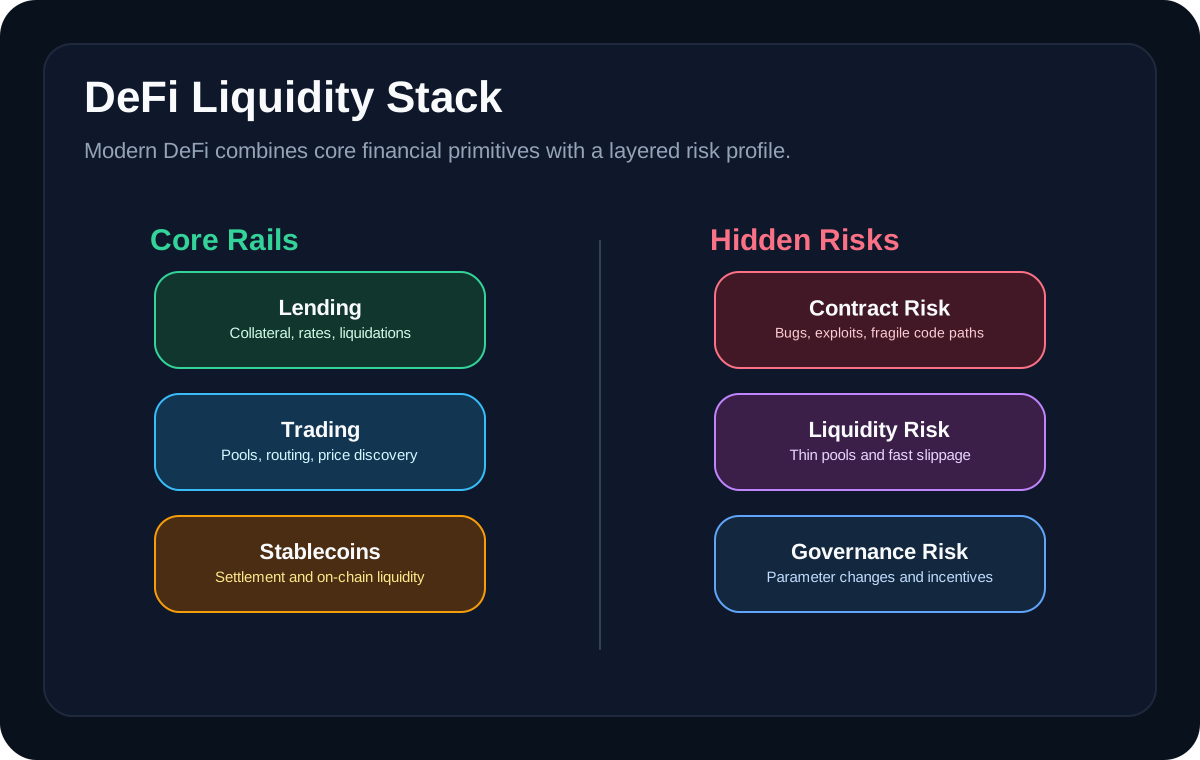
Modern DeFi is broader than early token farming. Today it includes lending markets, derivatives, stablecoin systems, restaking products, and specialized infrastructure that routes trades across many pools and chains. In simple terms: DeFi has matured from a few headline apps into a stack of financial building blocks.
**Decentralized Finance (DeFi)** becomes easier to understand when you translate it into a user flow instead of a definition. In practice, learners usually meet this idea while *posting stablecoins as collateral inside a lending app*, then discover that the visible app action sits on top of wallet permissions, network rules, liquidity, or settlement assumptions that are easy to miss the first time. That is why the safest beginner habit is to ask how the action works, what the hidden dependency is, and what part of the system would fail first under stress.
Most people do not get hurt by the concept itself. They get hurt by the shortcuts they take around it. *Assuming a popular app is automatically safe* can turn a simple workflow into an expensive mistake, and *treating yields, floor prices, or governance tokens as if they were risk-free* often becomes visible only after funds are already in motion. That is why good crypto education pairs the mechanics with practical failure modes instead of teaching the upside in isolation.
A useful way to test whether this idea is landing is to picture where it shows up in a real workflow. Someone might run into it while *posting stablecoins as collateral inside a lending app* or *moving between an exchange, a wallet, and a crypto app without leaving blockchain rails*, which is why the topic matters most once money, permissions, or liquidity are already in motion instead of while reading definitions in the abstract.
**Why this matters:** Decentralized Finance (DeFi) is more useful when you can connect it to Ethereum & Smart Contracts, Stablecoins, and Crypto Security. That broader map helps beginners judge when the tool fits, when a simpler path is safer, and which follow-on topic to study next before committing real money or signing real transactions.
The DeFi risk stack
DeFi risk now comes from several layers at once: smart-contract bugs, oracle failures, governance changes, bridge risk, liquidity shocks, and token incentive design. Why this matters: a protocol can look simple on the surface while hiding several dependencies underneath.
The real value of **the defi risk stack** is that it explains what is happening behind the button a beginner clicks. Whether someone is *moving between an exchange, a wallet, and a crypto app without leaving blockchain rails* or *swapping tokens in a decentralized exchange such as Uniswap*, the outcome depends on a chain of infrastructure choices such as custody, routing, execution, and final settlement. Once that chain is clear, the topic stops feeling like crypto magic and starts feeling like a system with understandable moving parts.
Most people do not get hurt by the concept itself. They get hurt by the shortcuts they take around it. *Treating yields, floor prices, or governance tokens as if they were risk-free* can turn a simple workflow into an expensive mistake, and *granting risky token approvals to the wrong contract* often becomes visible only after funds are already in motion. That is why good crypto education pairs the mechanics with practical failure modes instead of teaching the upside in isolation.
Beginners usually retain this faster when they attach it to a concrete decision rather than a glossary term. In practice, the concept becomes easier to trust and easier to question once you connect it to a workflow like *moving between an exchange, a wallet, and a crypto app without leaving blockchain rails* and ask what could break, slow down, or become expensive at each step.
**Why this matters:** Decentralized Finance (DeFi) is more useful when you can connect it to Ethereum & Smart Contracts, Stablecoins, and Crypto Security. That broader map helps beginners judge when the tool fits, when a simpler path is safer, and which follow-on topic to study next before committing real money or signing real transactions.
Visual Guides
Glossary
- TVL
- Total value locked, a common way of measuring how much capital is deposited in a DeFi protocol.
- Liquidity pool
- A smart-contract pool of assets used to power on-chain trading or lending.
- Collateral
- Assets pledged to secure a loan or borrowing position.
- Liquidation
- The forced closing of a borrowing position when collateral falls too low.
FAQ
What is decentralized finance (defi) in simple terms?
DeFi is a set of blockchain-based financial apps that let users trade, lend, borrow, and earn yield directly from wallets through smart contracts rather than bank-controlled systems.
Why does decentralized finance (defi) matter in crypto applications?
It matters because The important shift is that the entire system runs continuously on-chain.
What should learners watch out for with decentralized finance (defi)?
Watch for Users rely less on a bank branch and more on smart contract code, governance decisions, oracle systems, and the security of the blockchain underneath the app.
How does decentralized finance (defi) connect to the rest of crypto?
It connects to Ethereum & Smart Contracts, Stablecoins, Crypto Security. DeFi refers to financial services built on blockchains through smart contracts rather than banks.
What should I learn after decentralized finance (defi)?
Next, study Ethereum & Smart Contracts, Stablecoins, Crypto Security so you can connect this lesson to adjacent crypto concepts.