Crypto Applications
Crypto Security
Crypto security is the practice of protecting wallets, accounts, approvals, and on-chain behavior from scams, phishing, poor custody, and hidden protocol risk. It helps readers connect scams and rug pulls and phishing attacks while keeping the core tradeoffs and risks in view. Rug pulls happen when a project team or insiders drain liquidity, dump into buyers, or abandon a token after attracting attention and capital.
TL;DR
Review scams, phishing, approvals, wallet safety, and practical steps for protecting funds across modern crypto apps and platforms. It clarifies scams and rug pulls, phishing attacks, and smart contract risks so the lesson fits into the bigger crypto applications picture.
Scams and rug pulls
Crypto scams often promise unrealistic returns, fake urgency, or insider access to the next big token. Rug pulls happen when a project team or insiders drain liquidity, dump into buyers, or abandon a token after attracting attention and capital. The pattern is usually less sophisticated than beginners expect. Scammers lean on pressure, confusion, and greed far more often than deep technical exploits. If a project relies on urgency, vague claims, or influencer excitement instead of understandable mechanics, that is already useful risk information.
**Crypto Security** becomes easier to understand when you translate it into a user flow instead of a definition. In practice, learners usually meet this idea while *swapping tokens in a decentralized exchange such as Uniswap*, then discover that the visible app action sits on top of wallet permissions, network rules, liquidity, or settlement assumptions that are easy to miss the first time. That is why the safest beginner habit is to ask how the action works, what the hidden dependency is, and what part of the system would fail first under stress.
A common beginner mistake here is *granting risky token approvals to the wrong contract*. Another is *assuming a popular app is automatically safe*. Those errors usually do not come from bad intent; they come from skipping one layer of understanding and moving straight to the transaction. What can go wrong depends on the lesson, but the pattern is consistent: users either trust the wrong tool, underestimate timing and fees, or assume one network's rules apply everywhere. Slowing down long enough to verify the route, asset, counterparty, or contract address prevents a surprising share of early losses.
A useful way to test whether this idea is landing is to picture where it shows up in a real workflow. Someone might run into it while *swapping tokens in a decentralized exchange such as Uniswap* or *posting stablecoins as collateral inside a lending app*, which is why the topic matters most once money, permissions, or liquidity are already in motion instead of while reading definitions in the abstract.
**Why this matters:** Crypto Security is more useful when you can connect it to Crypto Wallets, DeFi, and Buying Your First Crypto. That broader map helps beginners judge when the tool fits, when a simpler path is safer, and which follow-on topic to study next before committing real money or signing real transactions.
For primary-source context, see [Ethereum security report](https://ethereum.org/reports/trillion-dollar-security.pdf), [Ethereum wallets guide](https://ethereum.org/en/wallets), and [Ethereum smart contracts docs](https://ethereum.org/developers/docs/smart-contracts/).
Phishing attacks
Phishing attacks trick users into revealing passwords, seed phrases, or wallet approvals through fake links, cloned sites, support impersonation, and malicious messages. In crypto, one careless signature or stolen recovery phrase can lead to irreversible loss of funds. That is why phishing is not just an email problem. It is a wallet behavior problem. Users can lose money by approving the wrong contract, connecting to the wrong site, or trusting a fake support account that looks convincing enough in a hurry.
The real value of **phishing attacks** is that it explains what is happening behind the button a beginner clicks. Whether someone is *posting stablecoins as collateral inside a lending app* or *moving between an exchange, a wallet, and a crypto app without leaving blockchain rails*, the outcome depends on a chain of infrastructure choices such as custody, routing, execution, and final settlement. Once that chain is clear, the topic stops feeling like crypto magic and starts feeling like a system with understandable moving parts.
Most people do not get hurt by the concept itself. They get hurt by the shortcuts they take around it. *Assuming a popular app is automatically safe* can turn a simple workflow into an expensive mistake, and *treating yields, floor prices, or governance tokens as if they were risk-free* often becomes visible only after funds are already in motion. That is why good crypto education pairs the mechanics with practical failure modes instead of teaching the upside in isolation.
Beginners usually retain this faster when they attach it to a concrete decision rather than a glossary term. In practice, the concept becomes easier to trust and easier to question once you connect it to a workflow like *posting stablecoins as collateral inside a lending app* and ask what could break, slow down, or become expensive at each step.
**Why this matters:** Crypto Security is more useful when you can connect it to Crypto Wallets, DeFi, and Buying Your First Crypto. That broader map helps beginners judge when the tool fits, when a simpler path is safer, and which follow-on topic to study next before committing real money or signing real transactions.
Smart contract risks
Even honest projects can contain code bugs, flawed incentives, or vulnerable integrations that put user funds at risk. A protocol can fail because of its own code, because an oracle breaks, because a bridge is compromised, or because the economic design behaves badly under pressure. Before using a protocol, it helps to review audits, protocol history, team credibility, and whether the design is simple enough to explain. Complexity is not proof of quality. In crypto, extra moving parts often mean extra ways for users to get hurt.
**Crypto Security** becomes easier to understand when you translate it into a user flow instead of a definition. In practice, learners usually meet this idea while *moving between an exchange, a wallet, and a crypto app without leaving blockchain rails*, then discover that the visible app action sits on top of wallet permissions, network rules, liquidity, or settlement assumptions that are easy to miss the first time. That is why the safest beginner habit is to ask how the action works, what the hidden dependency is, and what part of the system would fail first under stress.
Most people do not get hurt by the concept itself. They get hurt by the shortcuts they take around it. *Treating yields, floor prices, or governance tokens as if they were risk-free* can turn a simple workflow into an expensive mistake, and *granting risky token approvals to the wrong contract* often becomes visible only after funds are already in motion. That is why good crypto education pairs the mechanics with practical failure modes instead of teaching the upside in isolation.
A useful way to test whether this idea is landing is to picture where it shows up in a real workflow. Someone might run into it while *moving between an exchange, a wallet, and a crypto app without leaving blockchain rails* or *swapping tokens in a decentralized exchange such as Uniswap*, which is why the topic matters most once money, permissions, or liquidity are already in motion instead of while reading definitions in the abstract.
**Why this matters:** Crypto Security is more useful when you can connect it to Crypto Wallets, DeFi, and Buying Your First Crypto. That broader map helps beginners judge when the tool fits, when a simpler path is safer, and which follow-on topic to study next before committing real money or signing real transactions.
How to protect assets
Good security habits include using hardware wallets for larger balances, checking URLs carefully, limiting wallet permissions, and separating long-term storage from experimental activity. Small routines like test transactions, wallet separation, and two-factor authentication reduce risk more than most people expect. The bigger lesson is that crypto safety is usually procedural, not magical. Users who stay organized, double-check approvals, and avoid rushing through wallet actions are often much safer than users chasing perfect tools while keeping sloppy habits.
The real value of **how to protect assets** is that it explains what is happening behind the button a beginner clicks. Whether someone is *swapping tokens in a decentralized exchange such as Uniswap* or *posting stablecoins as collateral inside a lending app*, the outcome depends on a chain of infrastructure choices such as custody, routing, execution, and final settlement. Once that chain is clear, the topic stops feeling like crypto magic and starts feeling like a system with understandable moving parts.
A common beginner mistake here is *granting risky token approvals to the wrong contract*. Another is *assuming a popular app is automatically safe*. Those errors usually do not come from bad intent; they come from skipping one layer of understanding and moving straight to the transaction. What can go wrong depends on the lesson, but the pattern is consistent: users either trust the wrong tool, underestimate timing and fees, or assume one network's rules apply everywhere. Slowing down long enough to verify the route, asset, counterparty, or contract address prevents a surprising share of early losses.
Beginners usually retain this faster when they attach it to a concrete decision rather than a glossary term. In practice, the concept becomes easier to trust and easier to question once you connect it to a workflow like *swapping tokens in a decentralized exchange such as Uniswap* and ask what could break, slow down, or become expensive at each step.
**Why this matters:** Crypto Security is more useful when you can connect it to Crypto Wallets, DeFi, and Buying Your First Crypto. That broader map helps beginners judge when the tool fits, when a simpler path is safer, and which follow-on topic to study next before committing real money or signing real transactions.
Approval risk and wallet hygiene
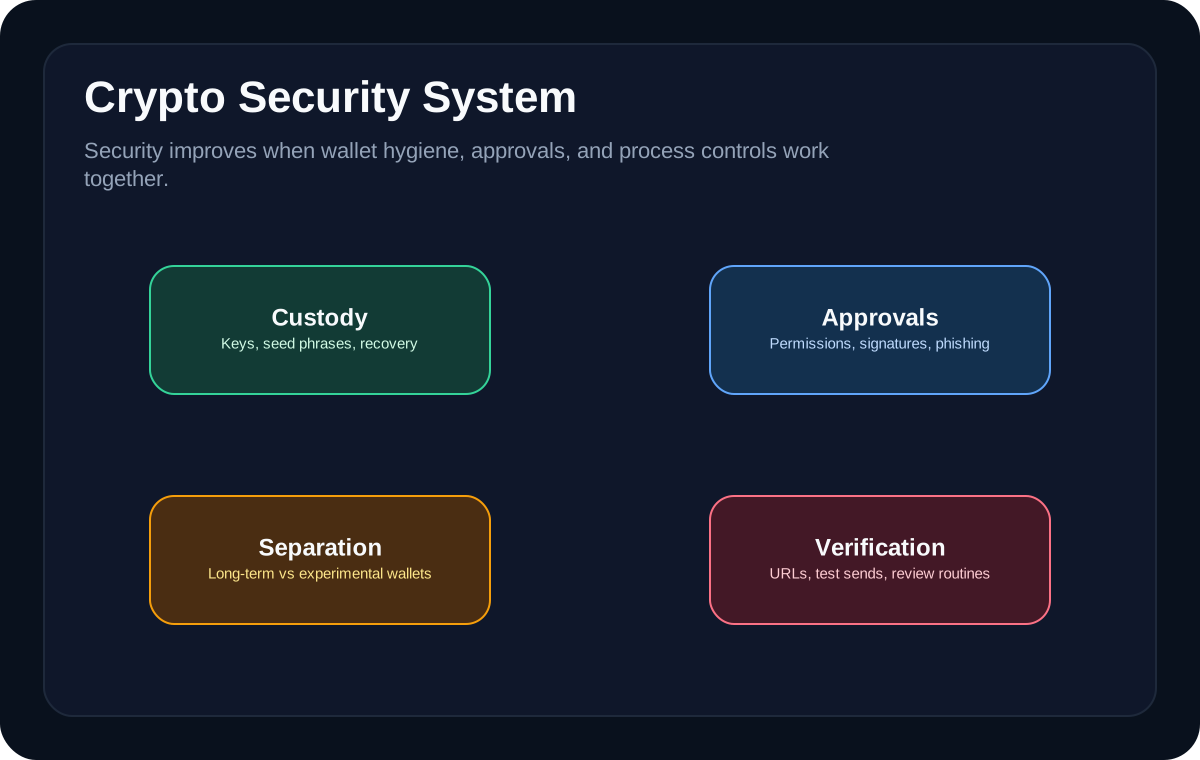
Modern crypto risk is not only about seed phrases. It is also about wallet approvals, connected apps, blind signatures, and staying organized across long-term and experimental wallets. In simple terms: security now includes how you interact, not just what you store.
**Crypto Security** becomes easier to understand when you translate it into a user flow instead of a definition. In practice, learners usually meet this idea while *posting stablecoins as collateral inside a lending app*, then discover that the visible app action sits on top of wallet permissions, network rules, liquidity, or settlement assumptions that are easy to miss the first time. That is why the safest beginner habit is to ask how the action works, what the hidden dependency is, and what part of the system would fail first under stress.
Most people do not get hurt by the concept itself. They get hurt by the shortcuts they take around it. *Assuming a popular app is automatically safe* can turn a simple workflow into an expensive mistake, and *treating yields, floor prices, or governance tokens as if they were risk-free* often becomes visible only after funds are already in motion. That is why good crypto education pairs the mechanics with practical failure modes instead of teaching the upside in isolation.
A useful way to test whether this idea is landing is to picture where it shows up in a real workflow. Someone might run into it while *posting stablecoins as collateral inside a lending app* or *moving between an exchange, a wallet, and a crypto app without leaving blockchain rails*, which is why the topic matters most once money, permissions, or liquidity are already in motion instead of while reading definitions in the abstract.
**Why this matters:** Crypto Security is more useful when you can connect it to Crypto Wallets, DeFi, and Buying Your First Crypto. That broader map helps beginners judge when the tool fits, when a simpler path is safer, and which follow-on topic to study next before committing real money or signing real transactions.
Security as a system, not a one-time checklist
Strong security comes from routines: verifying URLs, testing transfers, reviewing permissions, separating wallets by purpose, and keeping recovery data offline. Why this matters: most losses happen through repeated small mistakes, not one dramatic hack movie moment.
The real value of **security as a system, not a one-time checklist** is that it explains what is happening behind the button a beginner clicks. Whether someone is *moving between an exchange, a wallet, and a crypto app without leaving blockchain rails* or *swapping tokens in a decentralized exchange such as Uniswap*, the outcome depends on a chain of infrastructure choices such as custody, routing, execution, and final settlement. Once that chain is clear, the topic stops feeling like crypto magic and starts feeling like a system with understandable moving parts.
Most people do not get hurt by the concept itself. They get hurt by the shortcuts they take around it. *Treating yields, floor prices, or governance tokens as if they were risk-free* can turn a simple workflow into an expensive mistake, and *granting risky token approvals to the wrong contract* often becomes visible only after funds are already in motion. That is why good crypto education pairs the mechanics with practical failure modes instead of teaching the upside in isolation.
Beginners usually retain this faster when they attach it to a concrete decision rather than a glossary term. In practice, the concept becomes easier to trust and easier to question once you connect it to a workflow like *moving between an exchange, a wallet, and a crypto app without leaving blockchain rails* and ask what could break, slow down, or become expensive at each step.
**Why this matters:** Crypto Security is more useful when you can connect it to Crypto Wallets, DeFi, and Buying Your First Crypto. That broader map helps beginners judge when the tool fits, when a simpler path is safer, and which follow-on topic to study next before committing real money or signing real transactions.
Visual Guides
Glossary
- Scams and rug pulls
- Crypto scams often promise unrealistic returns, fake urgency, or insider access to the next big token. Rug pulls happen when a project team or insiders drain liquidity, dump into buyers, or abandon a token after attracting attention and capital.
- Phishing attacks
- Phishing attacks trick users into revealing passwords, seed phrases, or wallet approvals through fake links, cloned sites, support impersonation, and malicious messages. In crypto, one careless signature or stolen recovery phrase can lead to irreversible loss of funds.
- Smart contract risks
- Even honest projects can contain code bugs, flawed incentives, or vulnerable integrations that put user funds at risk. A protocol can fail because of its own code, because an oracle breaks, because a bridge is compromised, or because the economic design behaves badly under pressure.
- How to protect assets
- Good security habits include using hardware wallets for larger balances, checking URLs carefully, limiting wallet permissions, and separating long-term storage from experimental activity. Small routines like test transactions, wallet separation, and two-factor authentication reduce risk more than most people expect.
FAQ
What is crypto security in simple terms?
Crypto security is the practice of protecting wallets, accounts, approvals, and on-chain behavior from scams, phishing, poor custody, and hidden protocol risk.
Why does crypto security matter in crypto applications?
It matters because Rug pulls happen when a project team or insiders drain liquidity, dump into buyers, or abandon a token after attracting attention and capital.
What should learners watch out for with crypto security?
Watch for Crypto scams often promise unrealistic returns, fake urgency, or insider access to the next big token.
How does crypto security connect to the rest of crypto?
It connects to Crypto Wallets, DeFi, Buying Your First Crypto. Rug pulls happen when a project team or insiders drain liquidity, dump into buyers, or abandon a token after attracting attention and capital.
What should I learn after crypto security?
Next, study Crypto Wallets, DeFi, Buying Your First Crypto so you can connect this lesson to adjacent crypto concepts.