Stablecoin Systems
Stablecoins in Payments, DeFi, and Markets
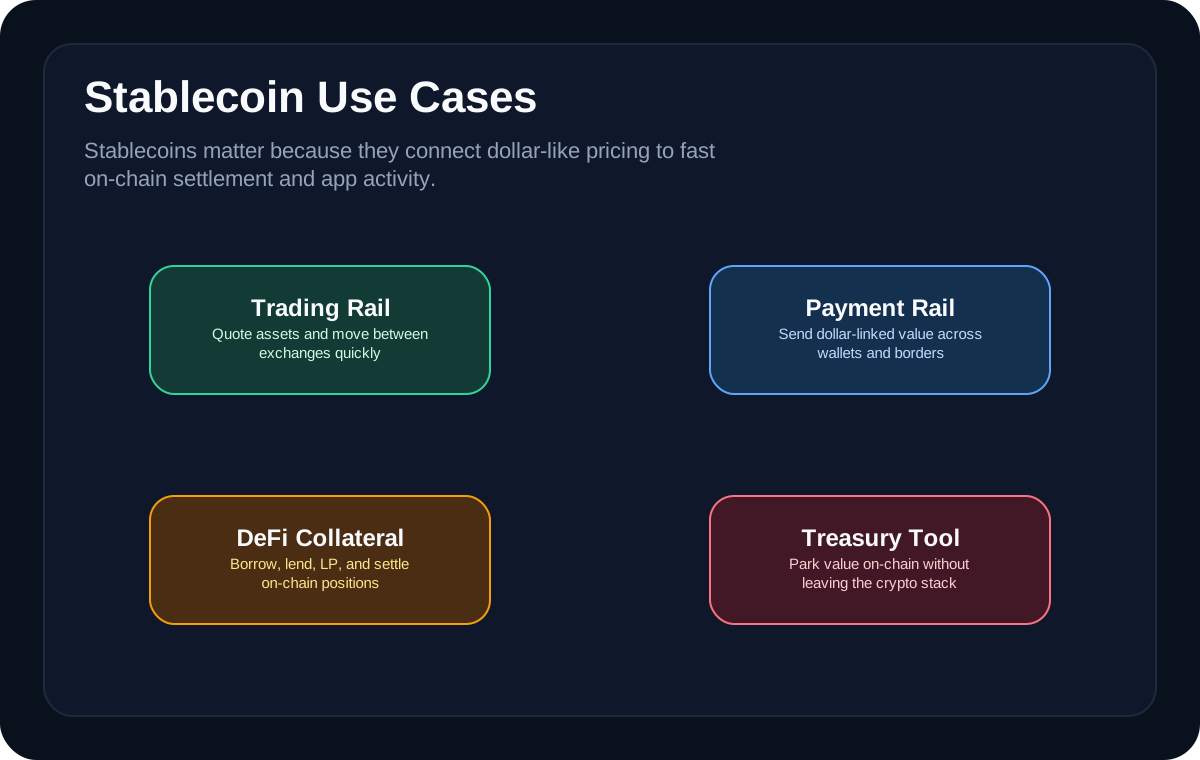
Stablecoins sit at the center of crypto because they make it easier to quote prices, settle positions, move cash-like value, and supply collateral without taking the same volatility as BTC or ETH. They are not just a side product. They are part of the market’s base infrastructure. It helps readers connect why trading routes through stablecoins and stablecoins in defi while keeping the core tradeoffs and risks in view. Stablecoins are core building blocks for lending markets, liquidity pools, collateral systems, automated trading, and on-chain savings products.
TL;DR
See why stablecoins became the cash layer for crypto trading, on-chain finance, and internet-native payments. It clarifies why trading routes through stablecoins, stablecoins in defi, and stablecoins in payments and settlement so the lesson fits into the bigger stablecoin systems picture.
Why trading routes through stablecoins
Stablecoins became the easiest quote asset for many exchanges because they let users move between volatile positions and dollar-like value without leaving crypto rails. They also make cross-platform settlement faster than constantly wiring funds through the banking system. In simple terms: stablecoins are the market’s working cash drawer.
**Stablecoins in Payments, DeFi, and Markets** becomes easier to understand when you translate it into a user flow instead of a definition. In practice, learners usually meet this idea while *using USDC or USDT as a quote asset on an exchange*, then discover that the visible app action sits on top of wallet permissions, network rules, liquidity, or settlement assumptions that are easy to miss the first time. That is why the safest beginner habit is to ask how the action works, what the hidden dependency is, and what part of the system would fail first under stress.
A common beginner mistake here is *assuming every one-dollar token has the same reserve quality*. Another is *ignoring freeze controls, redemption access, or oracle design*. Those errors usually do not come from bad intent; they come from skipping one layer of understanding and moving straight to the transaction. What can go wrong depends on the lesson, but the pattern is consistent: users either trust the wrong tool, underestimate timing and fees, or assume one network's rules apply everywhere. Slowing down long enough to verify the route, asset, counterparty, or contract address prevents a surprising share of early losses.
A useful way to test whether this idea is landing is to picture where it shows up in a real workflow. Someone might run into it while *using USDC or USDT as a quote asset on an exchange* or *borrowing against crypto collateral to mint a stablecoin-like position*, which is why the topic matters most once money, permissions, or liquidity are already in motion instead of while reading definitions in the abstract.
**Why this matters:** Stablecoins in Payments, DeFi, and Markets is more useful when you can connect it to DeFi, Crypto Wallets, and Future of Crypto. That broader map helps beginners judge when the tool fits, when a simpler path is safer, and which follow-on topic to study next before committing real money or signing real transactions.
For primary-source context, see [Ethereum stablecoins guide](https://ethereum.org/en/stablecoins/), [Ethereum DeFi guide](https://ethereum.org/pcm/defi/), and [Circle USDC overview](https://www.circle.com/usdc).
Stablecoins in DeFi
Stablecoins are core building blocks for lending markets, liquidity pools, collateral systems, automated trading, and on-chain savings products. Many DeFi apps become easier to understand once you notice that a stablecoin is often the unit tying the whole system together. Why this matters: stablecoins are not just used by DeFi, they often make DeFi possible.
The real value of **stablecoins in defi** is that it explains what is happening behind the button a beginner clicks. Whether someone is *borrowing against crypto collateral to mint a stablecoin-like position* or *sending dollar-like value between wallets for global settlement or payroll*, the outcome depends on a chain of infrastructure choices such as custody, routing, execution, and final settlement. Once that chain is clear, the topic stops feeling like crypto magic and starts feeling like a system with understandable moving parts.
Most people do not get hurt by the concept itself. They get hurt by the shortcuts they take around it. *Ignoring freeze controls, redemption access, or oracle design* can turn a simple workflow into an expensive mistake, and *judging safety from branding instead of peg-defense mechanics* often becomes visible only after funds are already in motion. That is why good crypto education pairs the mechanics with practical failure modes instead of teaching the upside in isolation.
Beginners usually retain this faster when they attach it to a concrete decision rather than a glossary term. In practice, the concept becomes easier to trust and easier to question once you connect it to a workflow like *borrowing against crypto collateral to mint a stablecoin-like position* and ask what could break, slow down, or become expensive at each step.
**Why this matters:** Stablecoins in Payments, DeFi, and Markets is more useful when you can connect it to DeFi, Crypto Wallets, and Future of Crypto. That broader map helps beginners judge when the tool fits, when a simpler path is safer, and which follow-on topic to study next before committing real money or signing real transactions.
Visual Guides
Stablecoins in payments and settlement
For payments, stablecoins can offer fast global transfers, simple wallet settlement, and always-on movement of dollar-like value. That makes them useful for remittances, treasury transfers, payroll experiments, and international business flows. What this means: stablecoins are often more interesting as rails than as investments.
**Stablecoins in Payments, DeFi, and Markets** becomes easier to understand when you translate it into a user flow instead of a definition. In practice, learners usually meet this idea while *sending dollar-like value between wallets for global settlement or payroll*, then discover that the visible app action sits on top of wallet permissions, network rules, liquidity, or settlement assumptions that are easy to miss the first time. That is why the safest beginner habit is to ask how the action works, what the hidden dependency is, and what part of the system would fail first under stress.
Most people do not get hurt by the concept itself. They get hurt by the shortcuts they take around it. *Judging safety from branding instead of peg-defense mechanics* can turn a simple workflow into an expensive mistake, and *assuming every one-dollar token has the same reserve quality* often becomes visible only after funds are already in motion. That is why good crypto education pairs the mechanics with practical failure modes instead of teaching the upside in isolation.
A useful way to test whether this idea is landing is to picture where it shows up in a real workflow. Someone might run into it while *sending dollar-like value between wallets for global settlement or payroll* or *using USDC or USDT as a quote asset on an exchange*, which is why the topic matters most once money, permissions, or liquidity are already in motion instead of while reading definitions in the abstract.
**Why this matters:** Stablecoins in Payments, DeFi, and Markets is more useful when you can connect it to DeFi, Crypto Wallets, and Future of Crypto. That broader map helps beginners judge when the tool fits, when a simpler path is safer, and which follow-on topic to study next before committing real money or signing real transactions.
Choosing a stablecoin for a job
The best stablecoin depends on what you need it for. Traders may care most about liquidity depth, payment users may care about settlement reach, and DeFi users may care about composability and collateral acceptance. Why this matters: there is no universal best stablecoin, only a better fit for a specific job.
The real value of **choosing a stablecoin for a job** is that it explains what is happening behind the button a beginner clicks. Whether someone is *using USDC or USDT as a quote asset on an exchange* or *borrowing against crypto collateral to mint a stablecoin-like position*, the outcome depends on a chain of infrastructure choices such as custody, routing, execution, and final settlement. Once that chain is clear, the topic stops feeling like crypto magic and starts feeling like a system with understandable moving parts.
A common beginner mistake here is *assuming every one-dollar token has the same reserve quality*. Another is *ignoring freeze controls, redemption access, or oracle design*. Those errors usually do not come from bad intent; they come from skipping one layer of understanding and moving straight to the transaction. What can go wrong depends on the lesson, but the pattern is consistent: users either trust the wrong tool, underestimate timing and fees, or assume one network's rules apply everywhere. Slowing down long enough to verify the route, asset, counterparty, or contract address prevents a surprising share of early losses.
Beginners usually retain this faster when they attach it to a concrete decision rather than a glossary term. In practice, the concept becomes easier to trust and easier to question once you connect it to a workflow like *using USDC or USDT as a quote asset on an exchange* and ask what could break, slow down, or become expensive at each step.
**Why this matters:** Stablecoins in Payments, DeFi, and Markets is more useful when you can connect it to DeFi, Crypto Wallets, and Future of Crypto. That broader map helps beginners judge when the tool fits, when a simpler path is safer, and which follow-on topic to study next before committing real money or signing real transactions.
- Start with the job you need the stablecoin to do.
- Check the token’s liquidity, redemption model, and trust assumptions.
- Confirm whether it is widely supported on the exchange, wallet, or chain you use.
- Compare control risk, collateral design, and any freeze or governance powers.
- Choose the simplest model that still fits your use case cleanly.
What to learn next
Stablecoins connect directly to DeFi, payments, wallets, regulation, and tokenized real-world assets. Once you understand stablecoins, many of the biggest adoption stories in crypto become easier to evaluate with a calmer and more practical lens. In simple terms: stablecoins are one of the fastest ways to understand where crypto is already useful.
**Stablecoins in Payments, DeFi, and Markets** becomes easier to understand when you translate it into a user flow instead of a definition. In practice, learners usually meet this idea while *borrowing against crypto collateral to mint a stablecoin-like position*, then discover that the visible app action sits on top of wallet permissions, network rules, liquidity, or settlement assumptions that are easy to miss the first time. That is why the safest beginner habit is to ask how the action works, what the hidden dependency is, and what part of the system would fail first under stress.
Most people do not get hurt by the concept itself. They get hurt by the shortcuts they take around it. *Ignoring freeze controls, redemption access, or oracle design* can turn a simple workflow into an expensive mistake, and *judging safety from branding instead of peg-defense mechanics* often becomes visible only after funds are already in motion. That is why good crypto education pairs the mechanics with practical failure modes instead of teaching the upside in isolation.
A useful way to test whether this idea is landing is to picture where it shows up in a real workflow. Someone might run into it while *borrowing against crypto collateral to mint a stablecoin-like position* or *sending dollar-like value between wallets for global settlement or payroll*, which is why the topic matters most once money, permissions, or liquidity are already in motion instead of while reading definitions in the abstract.
**Why this matters:** Stablecoins in Payments, DeFi, and Markets is more useful when you can connect it to DeFi, Crypto Wallets, and Future of Crypto. That broader map helps beginners judge when the tool fits, when a simpler path is safer, and which follow-on topic to study next before committing real money or signing real transactions.
Glossary
- Settlement
- The final movement or completion of value between parties or platforms.
- Composability
- The ability for crypto apps and tokens to plug into one another on shared blockchain rails.
- Quote asset
- The unit used to price other assets in a trading market.
- Treasury management
- How a company or protocol stores and moves its working capital.
FAQ
Why are stablecoins used as trading pairs so often?
Because they let exchanges and users denominate prices in a familiar dollar-like unit without relying on constant bank settlement. That makes them efficient trading and settlement rails.
Why do DeFi apps use stablecoins so heavily?
Because stablecoins reduce the noise from volatile pricing and make it easier to lend, borrow, quote collateral, and manage treasury flows on-chain. They become the accounting unit for many protocols.
Are stablecoins mainly an investment product?
Not really. Their main value usually comes from settlement, liquidity, payments, collateral, and operating utility rather than from upside price appreciation.
How do I choose between stablecoins for a practical use case?
Match the stablecoin to the job. Check liquidity, redemption design, chain support, issuer or protocol risk, and whether the token is accepted where you plan to use it.
What should I study after stablecoins?
DeFi, wallets, crypto security, regulation, and tokenized asset infrastructure are the best follow-on topics because stablecoins connect naturally to all of them.