Advanced Crypto
Layer 2 Scaling
Layer 2 scaling uses secondary systems like rollups to process more activity cheaply while still settling back to a stronger base layer such as Ethereum. It helps readers connect why scaling is needed and rollups (optimistic vs zk) while keeping the core tradeoffs and risks in view. Understanding that tradeoff helps explain why the Layer 2 landscape is diverse instead of converging on one single model.
TL;DR
Examine how rollups and related scaling systems improve throughput, reduce fees, and change the way blockchains are used in practice. It clarifies why scaling is needed, rollups (optimistic vs zk), and sidechains so the lesson fits into the bigger advanced crypto picture.
Why scaling is needed
Popular blockchains can become congested when more users want to transact than the base layer can handle efficiently. Scaling solutions are needed to increase throughput, reduce costs, and make blockchain applications practical for broader adoption. The core problem is not just technical capacity. It is user experience under demand. When fees spike and confirmations slow down, applications become harder to use and smaller transactions stop making sense. Scaling matters because a network that is too expensive or too crowded cannot support everyday activity very well.
**Layer 2 Scaling** becomes easier to understand when you translate it into a user flow instead of a definition. In practice, learners usually meet this idea while *comparing Ethereum mainnet congestion with lower-cost activity on rollups*, then discover that the visible app action sits on top of wallet permissions, network rules, liquidity, or settlement assumptions that are easy to miss the first time. That is why the safest beginner habit is to ask how the action works, what the hidden dependency is, and what part of the system would fail first under stress.
A common beginner mistake here is *memorizing jargon without mapping the tradeoff underneath it*. Another is *assuming the most decentralized design is always the most usable design*. Those errors usually do not come from bad intent; they come from skipping one layer of understanding and moving straight to the transaction. What can go wrong depends on the lesson, but the pattern is consistent: users either trust the wrong tool, underestimate timing and fees, or assume one network's rules apply everywhere. Slowing down long enough to verify the route, asset, counterparty, or contract address prevents a surprising share of early losses.
A useful way to test whether this idea is landing is to picture where it shows up in a real workflow. Someone might run into it while *comparing Ethereum mainnet congestion with lower-cost activity on rollups* or *reading token incentives to understand why a protocol can grow fast and still break later*, which is why the topic matters most once money, permissions, or liquidity are already in motion instead of while reading definitions in the abstract.
**Why this matters:** Layer 2 Scaling is more useful when you can connect it to Ethereum & Smart Contracts, How Blockchains Work, and Consensus Mechanisms. That broader map helps beginners judge when the tool fits, when a simpler path is safer, and which follow-on topic to study next before committing real money or signing real transactions.
For primary-source context, see [Optimism rollup overview](https://docs.optimism.io/concepts/architecture/rollups/overview), [Arbitrum rollup overview](https://arbitrum.io/rollup), and [Ethereum security report](https://ethereum.org/reports/trillion-dollar-security.pdf).
Rollups (Optimistic vs ZK)
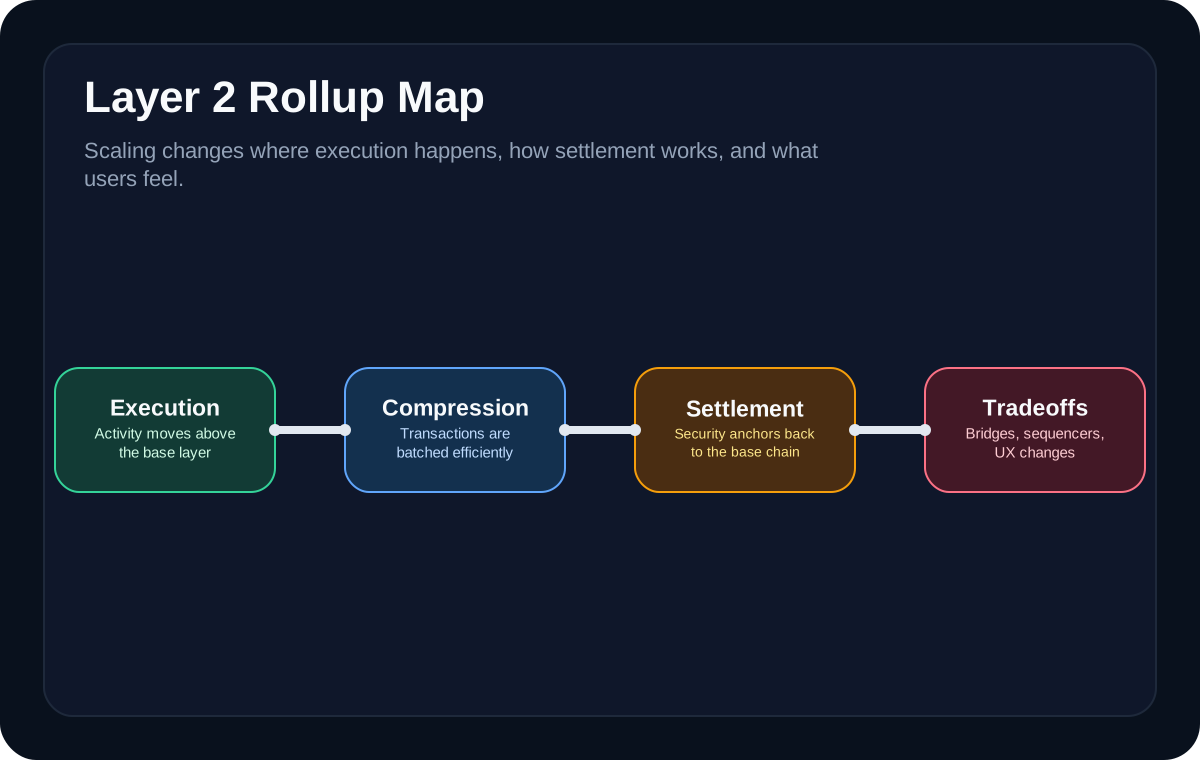
Rollups process many transactions off the main chain and then post compressed data back to the base layer. Optimistic rollups assume transactions are valid unless challenged, while ZK rollups use cryptographic proofs to verify correctness more directly. That difference changes the user experience around finality, withdrawals, proving costs, and system design. Both aim to scale activity without abandoning the settlement layer entirely, but they do so through different trust and verification paths. Understanding that tradeoff helps explain why the Layer 2 landscape is diverse instead of converging on one single model.
The real value of **rollups (optimistic vs zk)** is that it explains what is happening behind the button a beginner clicks. Whether someone is *reading token incentives to understand why a protocol can grow fast and still break later* or *using on-chain data, liquidity conditions, and narrative shifts together instead of in isolation*, the outcome depends on a chain of infrastructure choices such as custody, routing, execution, and final settlement. Once that chain is clear, the topic stops feeling like crypto magic and starts feeling like a system with understandable moving parts.
Most people do not get hurt by the concept itself. They get hurt by the shortcuts they take around it. *Assuming the most decentralized design is always the most usable design* can turn a simple workflow into an expensive mistake, and *reading a single metric as if it explains the whole market* often becomes visible only after funds are already in motion. That is why good crypto education pairs the mechanics with practical failure modes instead of teaching the upside in isolation.
Beginners usually retain this faster when they attach it to a concrete decision rather than a glossary term. In practice, the concept becomes easier to trust and easier to question once you connect it to a workflow like *reading token incentives to understand why a protocol can grow fast and still break later* and ask what could break, slow down, or become expensive at each step.
**Why this matters:** Layer 2 Scaling is more useful when you can connect it to Ethereum & Smart Contracts, How Blockchains Work, and Consensus Mechanisms. That broader map helps beginners judge when the tool fits, when a simpler path is safer, and which follow-on topic to study next before committing real money or signing real transactions.
Sidechains
Sidechains are separate blockchains connected to a main chain through bridges or interoperability tools. They can offer speed and lower fees, but they usually rely on their own validator set and therefore carry a different security model than true Layer 2 rollups. That distinction matters because many users treat every cheaper chain as if it inherits the same safety assumptions. It does not. A sidechain may be perfectly useful, but the security anchor is different, the trust model is different, and the bridge path can become a major part of the risk profile.
**Layer 2 Scaling** becomes easier to understand when you translate it into a user flow instead of a definition. In practice, learners usually meet this idea while *using on-chain data, liquidity conditions, and narrative shifts together instead of in isolation*, then discover that the visible app action sits on top of wallet permissions, network rules, liquidity, or settlement assumptions that are easy to miss the first time. That is why the safest beginner habit is to ask how the action works, what the hidden dependency is, and what part of the system would fail first under stress.
Most people do not get hurt by the concept itself. They get hurt by the shortcuts they take around it. *Reading a single metric as if it explains the whole market* can turn a simple workflow into an expensive mistake, and *memorizing jargon without mapping the tradeoff underneath it* often becomes visible only after funds are already in motion. That is why good crypto education pairs the mechanics with practical failure modes instead of teaching the upside in isolation.
A useful way to test whether this idea is landing is to picture where it shows up in a real workflow. Someone might run into it while *using on-chain data, liquidity conditions, and narrative shifts together instead of in isolation* or *comparing Ethereum mainnet congestion with lower-cost activity on rollups*, which is why the topic matters most once money, permissions, or liquidity are already in motion instead of while reading definitions in the abstract.
**Why this matters:** Layer 2 Scaling is more useful when you can connect it to Ethereum & Smart Contracts, How Blockchains Work, and Consensus Mechanisms. That broader map helps beginners judge when the tool fits, when a simpler path is safer, and which follow-on topic to study next before committing real money or signing real transactions.
Ethereum scaling roadmap
Ethereum's scaling roadmap increasingly centers around a rollup-focused future supported by better data availability and modular infrastructure. The goal is for the base chain to provide strong settlement and security while Layer 2 networks handle most day-to-day activity. That means Ethereum is evolving toward a layered ecosystem rather than trying to keep every transaction on mainnet forever. For users, the practical takeaway is simple: understanding Ethereum now increasingly means understanding the relationship between mainnet, rollups, bridges, and app-specific execution environments.
The real value of **ethereum scaling roadmap** is that it explains what is happening behind the button a beginner clicks. Whether someone is *comparing Ethereum mainnet congestion with lower-cost activity on rollups* or *reading token incentives to understand why a protocol can grow fast and still break later*, the outcome depends on a chain of infrastructure choices such as custody, routing, execution, and final settlement. Once that chain is clear, the topic stops feeling like crypto magic and starts feeling like a system with understandable moving parts.
A common beginner mistake here is *memorizing jargon without mapping the tradeoff underneath it*. Another is *assuming the most decentralized design is always the most usable design*. Those errors usually do not come from bad intent; they come from skipping one layer of understanding and moving straight to the transaction. What can go wrong depends on the lesson, but the pattern is consistent: users either trust the wrong tool, underestimate timing and fees, or assume one network's rules apply everywhere. Slowing down long enough to verify the route, asset, counterparty, or contract address prevents a surprising share of early losses.
Beginners usually retain this faster when they attach it to a concrete decision rather than a glossary term. In practice, the concept becomes easier to trust and easier to question once you connect it to a workflow like *comparing Ethereum mainnet congestion with lower-cost activity on rollups* and ask what could break, slow down, or become expensive at each step.
**Why this matters:** Layer 2 Scaling is more useful when you can connect it to Ethereum & Smart Contracts, How Blockchains Work, and Consensus Mechanisms. That broader map helps beginners judge when the tool fits, when a simpler path is safer, and which follow-on topic to study next before committing real money or signing real transactions.
Why rollups matter now
Rollups matter now because users expect lower fees and faster interactions without giving up settlement quality. As more activity moves to rollups, the practical experience of using Ethereum increasingly happens one layer above the base chain. Why this matters: scaling is no longer a side topic, it is part of the default user path.
**Layer 2 Scaling** becomes easier to understand when you translate it into a user flow instead of a definition. In practice, learners usually meet this idea while *reading token incentives to understand why a protocol can grow fast and still break later*, then discover that the visible app action sits on top of wallet permissions, network rules, liquidity, or settlement assumptions that are easy to miss the first time. That is why the safest beginner habit is to ask how the action works, what the hidden dependency is, and what part of the system would fail first under stress.
Most people do not get hurt by the concept itself. They get hurt by the shortcuts they take around it. *Assuming the most decentralized design is always the most usable design* can turn a simple workflow into an expensive mistake, and *reading a single metric as if it explains the whole market* often becomes visible only after funds are already in motion. That is why good crypto education pairs the mechanics with practical failure modes instead of teaching the upside in isolation.
A useful way to test whether this idea is landing is to picture where it shows up in a real workflow. Someone might run into it while *reading token incentives to understand why a protocol can grow fast and still break later* or *using on-chain data, liquidity conditions, and narrative shifts together instead of in isolation*, which is why the topic matters most once money, permissions, or liquidity are already in motion instead of while reading definitions in the abstract.
**Why this matters:** Layer 2 Scaling is more useful when you can connect it to Ethereum & Smart Contracts, How Blockchains Work, and Consensus Mechanisms. That broader map helps beginners judge when the tool fits, when a simpler path is safer, and which follow-on topic to study next before committing real money or signing real transactions.
The user view of Layer 2s
From the user side, Layer 2s change where assets live, how bridges matter, and which wallets, apps, and sequencers shape the experience. In simple terms: scaling is not just infrastructure, it changes the product layer too.
The real value of **the user view of layer 2s** is that it explains what is happening behind the button a beginner clicks. Whether someone is *using on-chain data, liquidity conditions, and narrative shifts together instead of in isolation* or *comparing Ethereum mainnet congestion with lower-cost activity on rollups*, the outcome depends on a chain of infrastructure choices such as custody, routing, execution, and final settlement. Once that chain is clear, the topic stops feeling like crypto magic and starts feeling like a system with understandable moving parts.
Most people do not get hurt by the concept itself. They get hurt by the shortcuts they take around it. *Reading a single metric as if it explains the whole market* can turn a simple workflow into an expensive mistake, and *memorizing jargon without mapping the tradeoff underneath it* often becomes visible only after funds are already in motion. That is why good crypto education pairs the mechanics with practical failure modes instead of teaching the upside in isolation.
Beginners usually retain this faster when they attach it to a concrete decision rather than a glossary term. In practice, the concept becomes easier to trust and easier to question once you connect it to a workflow like *using on-chain data, liquidity conditions, and narrative shifts together instead of in isolation* and ask what could break, slow down, or become expensive at each step.
**Why this matters:** Layer 2 Scaling is more useful when you can connect it to Ethereum & Smart Contracts, How Blockchains Work, and Consensus Mechanisms. That broader map helps beginners judge when the tool fits, when a simpler path is safer, and which follow-on topic to study next before committing real money or signing real transactions.
Visual Guides
Glossary
- Why scaling is needed
- Popular blockchains can become congested when more users want to transact than the base layer can handle efficiently. Scaling solutions are needed to increase throughput, reduce costs, and make blockchain applications practical for broader adoption.
- Rollups (Optimistic vs ZK)
- Rollups process many transactions off the main chain and then post compressed data back to the base layer. Optimistic rollups assume transactions are valid unless challenged, while ZK rollups use cryptographic proofs to verify correctness more directly.
- Sidechains
- Sidechains are separate blockchains connected to a main chain through bridges or interoperability tools. They can offer speed and lower fees, but they usually rely on their own validator set and therefore carry a different security model than true Layer 2 rollups.
- Ethereum scaling roadmap
- Ethereum's scaling roadmap increasingly centers around a rollup-focused future supported by better data availability and modular infrastructure. The goal is for the base chain to provide strong settlement and security while Layer 2 networks handle most day-to-day activity.
FAQ
What is layer 2 scaling in simple terms?
Layer 2 scaling uses secondary systems like rollups to process more activity cheaply while still settling back to a stronger base layer such as Ethereum.
Why does layer 2 scaling matter in advanced crypto?
It matters because Scaling matters because a network that is too expensive or too crowded cannot support everyday activity very well.
What should learners watch out for with layer 2 scaling?
Watch for When fees spike and confirmations slow down, applications become harder to use and smaller transactions stop making sense.
How does layer 2 scaling connect to the rest of crypto?
It connects to Ethereum & Smart Contracts, How Blockchains Work, Consensus Mechanisms. Scaling solutions are needed to increase throughput, reduce costs, and make blockchain applications practical for broader adoption.
What should I learn after layer 2 scaling?
Next, study Ethereum & Smart Contracts, How Blockchains Work, Consensus Mechanisms so you can connect this lesson to adjacent crypto concepts.