Crypto Fundamentals
Ethereum & Smart Contracts
Ethereum is a blockchain built for programmable applications. Instead of only moving value, it lets developers deploy smart contracts so users can trade, borrow, create NFTs, and use decentralized apps directly from a wallet. It helps readers connect what ethereum does differently and smart contracts explained simply while keeping the core tradeoffs and risks in view. Ethereum is often the bridge between learning about crypto assets and learning about crypto applications.
TL;DR
See how Ethereum expands blockchain utility with programmable smart contracts, wallets, and decentralized applications. It clarifies what ethereum does differently, smart contracts explained simply, and gas and transaction execution so the lesson fits into the bigger crypto fundamentals picture.
What Ethereum does differently
Ethereum goes beyond simple payments by letting developers write code that lives on the blockchain. That code can hold assets, enforce rules, and react to user transactions, which turns Ethereum into a platform for applications rather than only a payment system. In simple terms: Bitcoin mainly moves value, while Ethereum also runs apps.
**Ethereum & Smart Contracts** becomes easier to understand when you translate it into a user flow instead of a definition. In practice, learners usually meet this idea while *sending BTC from one self-custody wallet to another*, then discover that the visible app action sits on top of wallet permissions, network rules, liquidity, or settlement assumptions that are easy to miss the first time. That is why the safest beginner habit is to ask how the action works, what the hidden dependency is, and what part of the system would fail first under stress.
A common beginner mistake here is *confusing the wallet interface with the blockchain underneath it*. Another is *sending assets on the wrong network*. Those errors usually do not come from bad intent; they come from skipping one layer of understanding and moving straight to the transaction. What can go wrong depends on the lesson, but the pattern is consistent: users either trust the wrong tool, underestimate timing and fees, or assume one network's rules apply everywhere. Slowing down long enough to verify the route, asset, counterparty, or contract address prevents a surprising share of early losses.
A useful way to test whether this idea is landing is to picture where it shows up in a real workflow. Someone might run into it while *sending BTC from one self-custody wallet to another* or *using ETH to pay for a smart-contract action on Ethereum*, which is why the topic matters most once money, permissions, or liquidity are already in motion instead of while reading definitions in the abstract.
**Why this matters:** Ethereum & Smart Contracts is more useful when you can connect it to What Is Cryptocurrency, How Blockchains Work, and DeFi. That broader map helps beginners judge when the tool fits, when a simpler path is safer, and which follow-on topic to study next before committing real money or signing real transactions.
For primary-source context, see [Ethereum smart contracts docs](https://ethereum.org/developers/docs/smart-contracts/), [Ethereum hello-world contract tutorial](https://ethereum.org/developers/tutorials/hello-world-smart-contract/), and [Ethereum wallets guide](https://ethereum.org/en/wallets).
Smart contracts explained simply
A smart contract is code on the blockchain that automatically runs when users call it and the conditions are met. Instead of asking a company to update balances or enforce a rule, users interact with transparent software that follows the same logic for everyone. Why this matters: Ethereum apps are made of contracts that can be inspected and reused.
The real value of **smart contracts explained simply** is that it explains what is happening behind the button a beginner clicks. Whether someone is *using ETH to pay for a smart-contract action on Ethereum* or *holding stablecoins in a wallet before moving into an exchange or DeFi app*, the outcome depends on a chain of infrastructure choices such as custody, routing, execution, and final settlement. Once that chain is clear, the topic stops feeling like crypto magic and starts feeling like a system with understandable moving parts.
Most people do not get hurt by the concept itself. They get hurt by the shortcuts they take around it. *Sending assets on the wrong network* can turn a simple workflow into an expensive mistake, and *chasing price action before understanding custody, gas fees, and confirmations* often becomes visible only after funds are already in motion. That is why good crypto education pairs the mechanics with practical failure modes instead of teaching the upside in isolation.
Beginners usually retain this faster when they attach it to a concrete decision rather than a glossary term. In practice, the concept becomes easier to trust and easier to question once you connect it to a workflow like *using ETH to pay for a smart-contract action on Ethereum* and ask what could break, slow down, or become expensive at each step.
**Why this matters:** Ethereum & Smart Contracts is more useful when you can connect it to What Is Cryptocurrency, How Blockchains Work, and DeFi. That broader map helps beginners judge when the tool fits, when a simpler path is safer, and which follow-on topic to study next before committing real money or signing real transactions.
Gas and transaction execution
Gas is the fee paid for the computing work needed to process actions on Ethereum. A simple transfer usually costs less than a complicated DeFi transaction because more contract logic uses more network resources. What this means: gas is not a penalty for using Ethereum, it is the pricing system for network computation.
**Ethereum & Smart Contracts** becomes easier to understand when you translate it into a user flow instead of a definition. In practice, learners usually meet this idea while *holding stablecoins in a wallet before moving into an exchange or DeFi app*, then discover that the visible app action sits on top of wallet permissions, network rules, liquidity, or settlement assumptions that are easy to miss the first time. That is why the safest beginner habit is to ask how the action works, what the hidden dependency is, and what part of the system would fail first under stress.
Most people do not get hurt by the concept itself. They get hurt by the shortcuts they take around it. *Chasing price action before understanding custody, gas fees, and confirmations* can turn a simple workflow into an expensive mistake, and *confusing the wallet interface with the blockchain underneath it* often becomes visible only after funds are already in motion. That is why good crypto education pairs the mechanics with practical failure modes instead of teaching the upside in isolation.
A useful way to test whether this idea is landing is to picture where it shows up in a real workflow. Someone might run into it while *holding stablecoins in a wallet before moving into an exchange or DeFi app* or *sending BTC from one self-custody wallet to another*, which is why the topic matters most once money, permissions, or liquidity are already in motion instead of while reading definitions in the abstract.
**Why this matters:** Ethereum & Smart Contracts is more useful when you can connect it to What Is Cryptocurrency, How Blockchains Work, and DeFi. That broader map helps beginners judge when the tool fits, when a simpler path is safer, and which follow-on topic to study next before committing real money or signing real transactions.
How users interact with Ethereum apps
Most users connect a wallet, choose a decentralized app, and approve transactions when they want a smart contract to do something. That flow could mean swapping tokens, borrowing against collateral, minting an NFT, or joining an on-chain game. In simple terms: your wallet is the interface, and smart contracts are the app logic underneath.
The real value of **how users interact with ethereum apps** is that it explains what is happening behind the button a beginner clicks. Whether someone is *sending BTC from one self-custody wallet to another* or *using ETH to pay for a smart-contract action on Ethereum*, the outcome depends on a chain of infrastructure choices such as custody, routing, execution, and final settlement. Once that chain is clear, the topic stops feeling like crypto magic and starts feeling like a system with understandable moving parts.
A common beginner mistake here is *confusing the wallet interface with the blockchain underneath it*. Another is *sending assets on the wrong network*. Those errors usually do not come from bad intent; they come from skipping one layer of understanding and moving straight to the transaction. What can go wrong depends on the lesson, but the pattern is consistent: users either trust the wrong tool, underestimate timing and fees, or assume one network's rules apply everywhere. Slowing down long enough to verify the route, asset, counterparty, or contract address prevents a surprising share of early losses.
Beginners usually retain this faster when they attach it to a concrete decision rather than a glossary term. In practice, the concept becomes easier to trust and easier to question once you connect it to a workflow like *sending BTC from one self-custody wallet to another* and ask what could break, slow down, or become expensive at each step.
**Why this matters:** Ethereum & Smart Contracts is more useful when you can connect it to What Is Cryptocurrency, How Blockchains Work, and DeFi. That broader map helps beginners judge when the tool fits, when a simpler path is safer, and which follow-on topic to study next before committing real money or signing real transactions.
Visual Guides
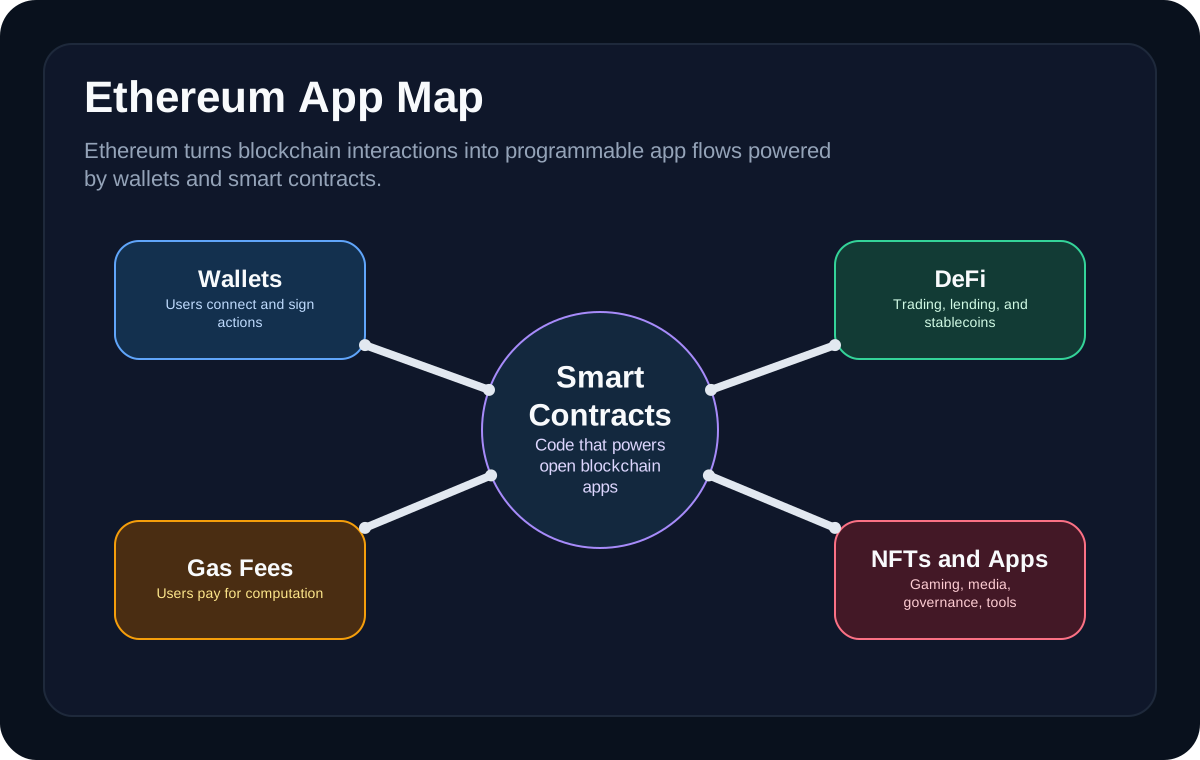
Ethereum ecosystem overview
The Ethereum ecosystem includes wallets, DeFi protocols, NFT platforms, DAOs, developer tools, stablecoins, and Layer 2 networks. Because so many products are built on the same programmable base, Ethereum became one of the main hubs for crypto experimentation and adoption. Why this matters: understanding Ethereum gives you a map for understanding much of modern crypto activity.
**Ethereum & Smart Contracts** becomes easier to understand when you translate it into a user flow instead of a definition. In practice, learners usually meet this idea while *using ETH to pay for a smart-contract action on Ethereum*, then discover that the visible app action sits on top of wallet permissions, network rules, liquidity, or settlement assumptions that are easy to miss the first time. That is why the safest beginner habit is to ask how the action works, what the hidden dependency is, and what part of the system would fail first under stress.
Most people do not get hurt by the concept itself. They get hurt by the shortcuts they take around it. *Sending assets on the wrong network* can turn a simple workflow into an expensive mistake, and *chasing price action before understanding custody, gas fees, and confirmations* often becomes visible only after funds are already in motion. That is why good crypto education pairs the mechanics with practical failure modes instead of teaching the upside in isolation.
A useful way to test whether this idea is landing is to picture where it shows up in a real workflow. Someone might run into it while *using ETH to pay for a smart-contract action on Ethereum* or *holding stablecoins in a wallet before moving into an exchange or DeFi app*, which is why the topic matters most once money, permissions, or liquidity are already in motion instead of while reading definitions in the abstract.
**Why this matters:** Ethereum & Smart Contracts is more useful when you can connect it to What Is Cryptocurrency, How Blockchains Work, and DeFi. That broader map helps beginners judge when the tool fits, when a simpler path is safer, and which follow-on topic to study next before committing real money or signing real transactions.
Why Ethereum matters to beginners
Ethereum matters because it introduces the app layer of crypto. Once you understand smart contracts, wallets, and gas, you can understand how DeFi, NFTs, governance tokens, and many Web3 products actually function. What this means: Ethereum is often the bridge between learning about crypto assets and learning about crypto applications.
The real value of **why ethereum matters to beginners** is that it explains what is happening behind the button a beginner clicks. Whether someone is *holding stablecoins in a wallet before moving into an exchange or DeFi app* or *sending BTC from one self-custody wallet to another*, the outcome depends on a chain of infrastructure choices such as custody, routing, execution, and final settlement. Once that chain is clear, the topic stops feeling like crypto magic and starts feeling like a system with understandable moving parts.
Most people do not get hurt by the concept itself. They get hurt by the shortcuts they take around it. *Chasing price action before understanding custody, gas fees, and confirmations* can turn a simple workflow into an expensive mistake, and *confusing the wallet interface with the blockchain underneath it* often becomes visible only after funds are already in motion. That is why good crypto education pairs the mechanics with practical failure modes instead of teaching the upside in isolation.
Beginners usually retain this faster when they attach it to a concrete decision rather than a glossary term. In practice, the concept becomes easier to trust and easier to question once you connect it to a workflow like *holding stablecoins in a wallet before moving into an exchange or DeFi app* and ask what could break, slow down, or become expensive at each step.
**Why this matters:** Ethereum & Smart Contracts is more useful when you can connect it to What Is Cryptocurrency, How Blockchains Work, and DeFi. That broader map helps beginners judge when the tool fits, when a simpler path is safer, and which follow-on topic to study next before committing real money or signing real transactions.
- A developer writes and deploys a smart contract.
- A user connects a wallet to an Ethereum app.
- The user approves a transaction that calls the contract.
- Ethereum validators process the transaction and update the chain state.
- The app result appears in the user’s wallet or on the app interface.
Glossary
- Smart contract
- Blockchain code that runs automatically when users call it under defined rules.
- Gas
- The fee paid for computation and transaction processing on Ethereum.
- dApp
- A decentralized application that uses smart contracts and blockchain-based components.
- ETH
- The native asset of Ethereum, used for fees and many on-chain interactions.
FAQ
What is the easiest way to think about Ethereum?
Think of Ethereum as a blockchain computer for open apps. It still moves value, but it also runs smart-contract logic that powers many crypto products.
What is a smart contract in simple terms?
It is blockchain-based code that follows preset rules when users interact with it. Smart contracts replace much of the middle-office logic that companies would normally run on private servers.
Why do Ethereum transactions need gas?
Gas pays for the network computation needed to process a transaction or contract call. More complex actions use more resources, so they usually cost more.
Is Ethereum the same as Ether?
Ethereum is the network, and Ether (ETH) is the native asset used to pay fees and interact with the chain. People often use the names interchangeably, but they refer to different things.
What kinds of apps run on Ethereum?
Common examples include DeFi protocols, NFT marketplaces, DAOs, on-chain games, stablecoin systems, and many infrastructure tools built for wallets and developers.