Crypto Applications
NFTs
NFTs are blockchain-based tokens that represent unique digital items, membership rights, or records of ownership, and today they are used in art, gaming, identity, ticketing, and brand ecosystems. It helps readers connect what nfts represent and digital ownership while keeping the core tradeoffs and risks in view. Pricing, creator royalties, wallet approvals, chain choice, and project reputation all affect the experience.
TL;DR
Understand digital ownership, NFT utility, and how non-fungible assets are used across art, gaming, memberships, and on-chain identity. It clarifies what nfts represent, digital ownership, and nft marketplaces so the lesson fits into the bigger crypto applications picture.
What NFTs represent
NFTs are unique blockchain-based tokens that represent ownership of a specific item, record, or membership position. Unlike interchangeable assets such as bitcoin, each NFT points to a distinct identity, asset, or access right rather than a perfectly identical unit. That uniqueness is the whole point. NFTs are useful when an asset should not be interchangeable, such as event access, game items, collectible art, certificates, or membership passes. The token becomes a portable ownership or access layer that can move with the user's wallet.
**NFTs** becomes easier to understand when you translate it into a user flow instead of a definition. In practice, learners usually meet this idea while *swapping tokens in a decentralized exchange such as Uniswap*, then discover that the visible app action sits on top of wallet permissions, network rules, liquidity, or settlement assumptions that are easy to miss the first time. That is why the safest beginner habit is to ask how the action works, what the hidden dependency is, and what part of the system would fail first under stress.
A common beginner mistake here is *granting risky token approvals to the wrong contract*. Another is *assuming a popular app is automatically safe*. Those errors usually do not come from bad intent; they come from skipping one layer of understanding and moving straight to the transaction. What can go wrong depends on the lesson, but the pattern is consistent: users either trust the wrong tool, underestimate timing and fees, or assume one network's rules apply everywhere. Slowing down long enough to verify the route, asset, counterparty, or contract address prevents a surprising share of early losses.
A useful way to test whether this idea is landing is to picture where it shows up in a real workflow. Someone might run into it while *swapping tokens in a decentralized exchange such as Uniswap* or *posting stablecoins as collateral inside a lending app*, which is why the topic matters most once money, permissions, or liquidity are already in motion instead of while reading definitions in the abstract.
**Why this matters:** NFTs is more useful when you can connect it to Ethereum & Smart Contracts, Web3 Ecosystem, and Crypto Security. That broader map helps beginners judge when the tool fits, when a simpler path is safer, and which follow-on topic to study next before committing real money or signing real transactions.
For primary-source context, see [Ethereum NFT guide](https://ethereum.org/de/nft/), [ERC-721 standard](https://ethereum.org/developers/docs/standards/tokens/erc-721), and [Ethereum token standards](https://ethereum.org/developers/docs/standards/tokens/).
Digital ownership
NFTs introduced a way to make digital ownership transferable and verifiable on open networks. They do not magically guarantee copyright, trademark control, or commercial rights, but they can provide a transparent on-chain record of who holds a particular token at a given moment. That distinction matters because many beginners confuse token ownership with every possible legal right around the underlying media. In reality, the NFT proves control of the token, while the project or creator still decides what additional rights or benefits come with holding it.
The real value of **digital ownership** is that it explains what is happening behind the button a beginner clicks. Whether someone is *posting stablecoins as collateral inside a lending app* or *moving between an exchange, a wallet, and a crypto app without leaving blockchain rails*, the outcome depends on a chain of infrastructure choices such as custody, routing, execution, and final settlement. Once that chain is clear, the topic stops feeling like crypto magic and starts feeling like a system with understandable moving parts.
Most people do not get hurt by the concept itself. They get hurt by the shortcuts they take around it. *Assuming a popular app is automatically safe* can turn a simple workflow into an expensive mistake, and *treating yields, floor prices, or governance tokens as if they were risk-free* often becomes visible only after funds are already in motion. That is why good crypto education pairs the mechanics with practical failure modes instead of teaching the upside in isolation.
Beginners usually retain this faster when they attach it to a concrete decision rather than a glossary term. In practice, the concept becomes easier to trust and easier to question once you connect it to a workflow like *posting stablecoins as collateral inside a lending app* and ask what could break, slow down, or become expensive at each step.
**Why this matters:** NFTs is more useful when you can connect it to Ethereum & Smart Contracts, Web3 Ecosystem, and Crypto Security. That broader map helps beginners judge when the tool fits, when a simpler path is safer, and which follow-on topic to study next before committing real money or signing real transactions.
NFT marketplaces
NFT marketplaces are platforms where users mint, list, buy, and sell non-fungible tokens. They typically connect to wallets and support collections across art, gaming, collectibles, memberships, and community-based products. What beginners should notice is that a marketplace is only one layer of the system. Pricing, creator royalties, wallet approvals, chain choice, and project reputation all affect the experience. Buying an NFT is not just browsing images; it is interacting with a token standard, a wallet flow, and a project ecosystem at the same time.
**NFTs** becomes easier to understand when you translate it into a user flow instead of a definition. In practice, learners usually meet this idea while *moving between an exchange, a wallet, and a crypto app without leaving blockchain rails*, then discover that the visible app action sits on top of wallet permissions, network rules, liquidity, or settlement assumptions that are easy to miss the first time. That is why the safest beginner habit is to ask how the action works, what the hidden dependency is, and what part of the system would fail first under stress.
Most people do not get hurt by the concept itself. They get hurt by the shortcuts they take around it. *Treating yields, floor prices, or governance tokens as if they were risk-free* can turn a simple workflow into an expensive mistake, and *granting risky token approvals to the wrong contract* often becomes visible only after funds are already in motion. That is why good crypto education pairs the mechanics with practical failure modes instead of teaching the upside in isolation.
A useful way to test whether this idea is landing is to picture where it shows up in a real workflow. Someone might run into it while *moving between an exchange, a wallet, and a crypto app without leaving blockchain rails* or *swapping tokens in a decentralized exchange such as Uniswap*, which is why the topic matters most once money, permissions, or liquidity are already in motion instead of while reading definitions in the abstract.
**Why this matters:** NFTs is more useful when you can connect it to Ethereum & Smart Contracts, Web3 Ecosystem, and Crypto Security. That broader map helps beginners judge when the tool fits, when a simpler path is safer, and which follow-on topic to study next before committing real money or signing real transactions.
Utility NFTs vs art NFTs
Art NFTs are often valued for aesthetics, cultural relevance, and creator reputation, while utility NFTs unlock access, perks, governance rights, or in-app functions. In practice, many real-world projects blend both by combining visual branding with membership or product benefits. That blend is why evaluating NFTs requires more than asking whether the image looks good. The stronger question is what ownership actually does for the holder. If the token gives no meaningful access, no durable status, and no useful role in a product or community, demand can fade quickly once attention moves elsewhere.
The real value of **utility nfts vs art nfts** is that it explains what is happening behind the button a beginner clicks. Whether someone is *swapping tokens in a decentralized exchange such as Uniswap* or *posting stablecoins as collateral inside a lending app*, the outcome depends on a chain of infrastructure choices such as custody, routing, execution, and final settlement. Once that chain is clear, the topic stops feeling like crypto magic and starts feeling like a system with understandable moving parts.
A common beginner mistake here is *granting risky token approvals to the wrong contract*. Another is *assuming a popular app is automatically safe*. Those errors usually do not come from bad intent; they come from skipping one layer of understanding and moving straight to the transaction. What can go wrong depends on the lesson, but the pattern is consistent: users either trust the wrong tool, underestimate timing and fees, or assume one network's rules apply everywhere. Slowing down long enough to verify the route, asset, counterparty, or contract address prevents a surprising share of early losses.
Beginners usually retain this faster when they attach it to a concrete decision rather than a glossary term. In practice, the concept becomes easier to trust and easier to question once you connect it to a workflow like *swapping tokens in a decentralized exchange such as Uniswap* and ask what could break, slow down, or become expensive at each step.
**Why this matters:** NFTs is more useful when you can connect it to Ethereum & Smart Contracts, Web3 Ecosystem, and Crypto Security. That broader map helps beginners judge when the tool fits, when a simpler path is safer, and which follow-on topic to study next before committing real money or signing real transactions.
NFTs beyond profile pictures
The strongest current NFT use cases go beyond collectibles. Projects now use NFTs for gaming items, event access, brand loyalty programs, creator communities, and identity-style credentials. What this means: the long-term value of NFTs depends more on utility and network effects than on hype alone.
**NFTs** becomes easier to understand when you translate it into a user flow instead of a definition. In practice, learners usually meet this idea while *posting stablecoins as collateral inside a lending app*, then discover that the visible app action sits on top of wallet permissions, network rules, liquidity, or settlement assumptions that are easy to miss the first time. That is why the safest beginner habit is to ask how the action works, what the hidden dependency is, and what part of the system would fail first under stress.
Most people do not get hurt by the concept itself. They get hurt by the shortcuts they take around it. *Assuming a popular app is automatically safe* can turn a simple workflow into an expensive mistake, and *treating yields, floor prices, or governance tokens as if they were risk-free* often becomes visible only after funds are already in motion. That is why good crypto education pairs the mechanics with practical failure modes instead of teaching the upside in isolation.
A useful way to test whether this idea is landing is to picture where it shows up in a real workflow. Someone might run into it while *posting stablecoins as collateral inside a lending app* or *moving between an exchange, a wallet, and a crypto app without leaving blockchain rails*, which is why the topic matters most once money, permissions, or liquidity are already in motion instead of while reading definitions in the abstract.
**Why this matters:** NFTs is more useful when you can connect it to Ethereum & Smart Contracts, Web3 Ecosystem, and Crypto Security. That broader map helps beginners judge when the tool fits, when a simpler path is safer, and which follow-on topic to study next before committing real money or signing real transactions.
Visual Guides
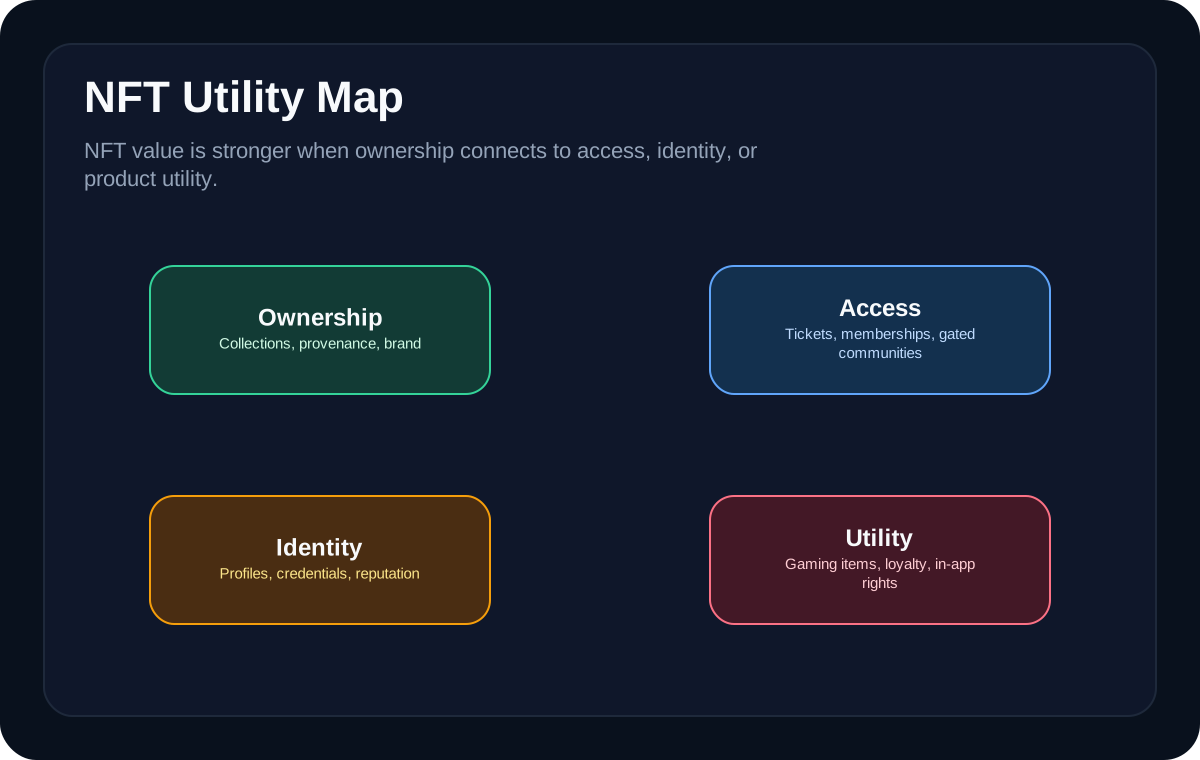
How to evaluate NFT utility
A useful NFT should answer a simple question: what does holding this token let you do, access, or prove? If the answer is vague, demand and retention often fade quickly. Why this matters: utility is easier to defend than attention.
The real value of **how to evaluate nft utility** is that it explains what is happening behind the button a beginner clicks. Whether someone is *moving between an exchange, a wallet, and a crypto app without leaving blockchain rails* or *swapping tokens in a decentralized exchange such as Uniswap*, the outcome depends on a chain of infrastructure choices such as custody, routing, execution, and final settlement. Once that chain is clear, the topic stops feeling like crypto magic and starts feeling like a system with understandable moving parts.
Most people do not get hurt by the concept itself. They get hurt by the shortcuts they take around it. *Treating yields, floor prices, or governance tokens as if they were risk-free* can turn a simple workflow into an expensive mistake, and *granting risky token approvals to the wrong contract* often becomes visible only after funds are already in motion. That is why good crypto education pairs the mechanics with practical failure modes instead of teaching the upside in isolation.
Beginners usually retain this faster when they attach it to a concrete decision rather than a glossary term. In practice, the concept becomes easier to trust and easier to question once you connect it to a workflow like *moving between an exchange, a wallet, and a crypto app without leaving blockchain rails* and ask what could break, slow down, or become expensive at each step.
**Why this matters:** NFTs is more useful when you can connect it to Ethereum & Smart Contracts, Web3 Ecosystem, and Crypto Security. That broader map helps beginners judge when the tool fits, when a simpler path is safer, and which follow-on topic to study next before committing real money or signing real transactions.
Glossary
- What NFTs represent
- NFTs are unique blockchain-based tokens that represent ownership of a specific item, record, or membership position. Unlike interchangeable assets such as bitcoin, each NFT points to a distinct identity, asset, or access right rather than a perfectly identical unit.
- Digital ownership
- NFTs introduced a way to make digital ownership transferable and verifiable on open networks. They do not magically guarantee copyright, trademark control, or commercial rights, but they can provide a transparent on-chain record of who holds a particular token at a given moment.
- NFT marketplaces
- NFT marketplaces are platforms where users mint, list, buy, and sell non-fungible tokens. They typically connect to wallets and support collections across art, gaming, collectibles, memberships, and community-based products.
- Utility NFTs vs art NFTs
- Art NFTs are often valued for aesthetics, cultural relevance, and creator reputation, while utility NFTs unlock access, perks, governance rights, or in-app functions. In practice, many real-world projects blend both by combining visual branding with membership or product benefits.
FAQ
What is nfts in simple terms?
NFTs are blockchain-based tokens that represent unique digital items, membership rights, or records of ownership, and today they are used in art, gaming, identity, ticketing, and brand ecosystems.
Why does nfts matter in crypto applications?
It matters because That distinction matters because many beginners confuse token ownership with every possible legal right around the underlying media.
What should learners watch out for with nfts?
Watch for Art NFTs are often valued for aesthetics, cultural relevance, and creator reputation, while utility NFTs unlock access, perks, governance rights, or in-app functions.
How does nfts connect to the rest of crypto?
It connects to Ethereum & Smart Contracts, Web3 Ecosystem, Crypto Security. The token becomes a portable ownership or access layer that can move with the user's wallet.
What should I learn after nfts?
Next, study Ethereum & Smart Contracts, Web3 Ecosystem, Crypto Security so you can connect this lesson to adjacent crypto concepts.