Staking & Yield
How Staking Works
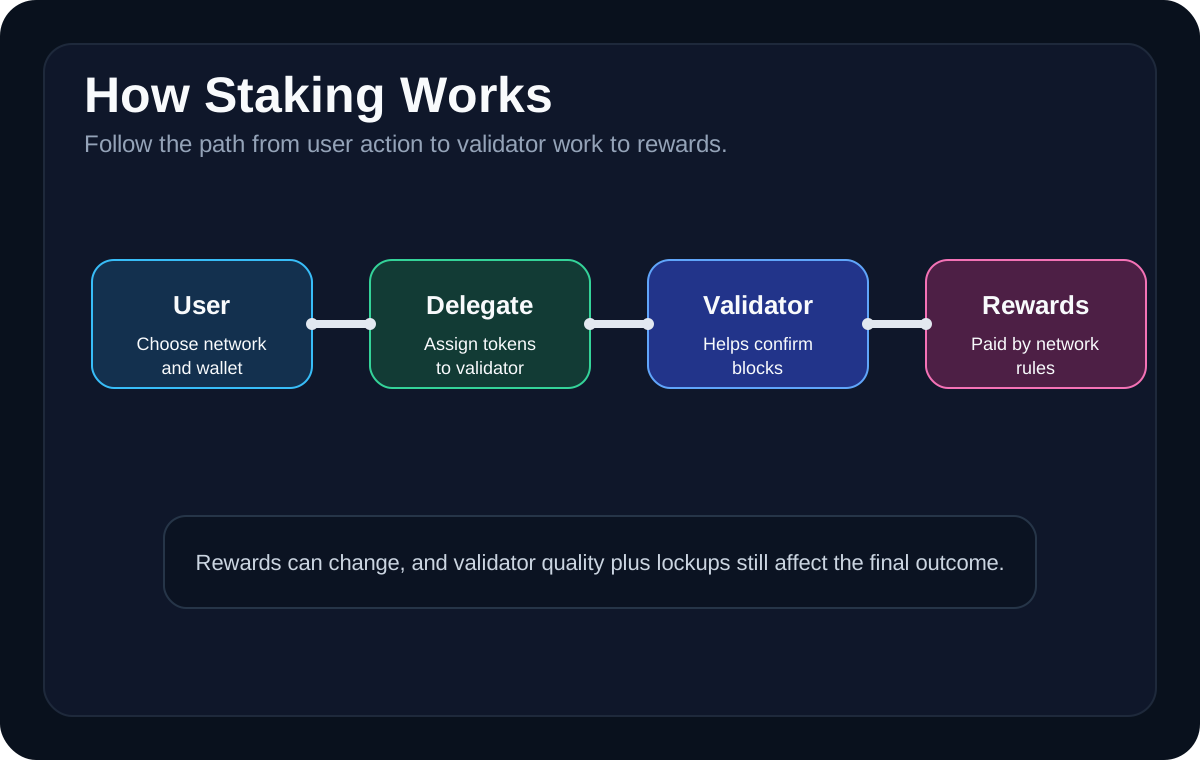
Staking works by assigning your tokens to a validator that helps confirm transactions on a proof-of-stake network. If that validator performs well, the network pays rewards from new token issuance, transaction fees, or both. It helps readers connect validators and delegators and how rewards are earned while keeping the core tradeoffs and risks in view. Staking turns token ownership into a security system for the network.
TL;DR
See how staking moves from a wallet action to validator work and reward payouts in a clear step-by-step flow. It clarifies validators and delegators, how rewards are earned, and lockups and unbonding so the lesson fits into the bigger staking & yield picture.
Validators and delegators
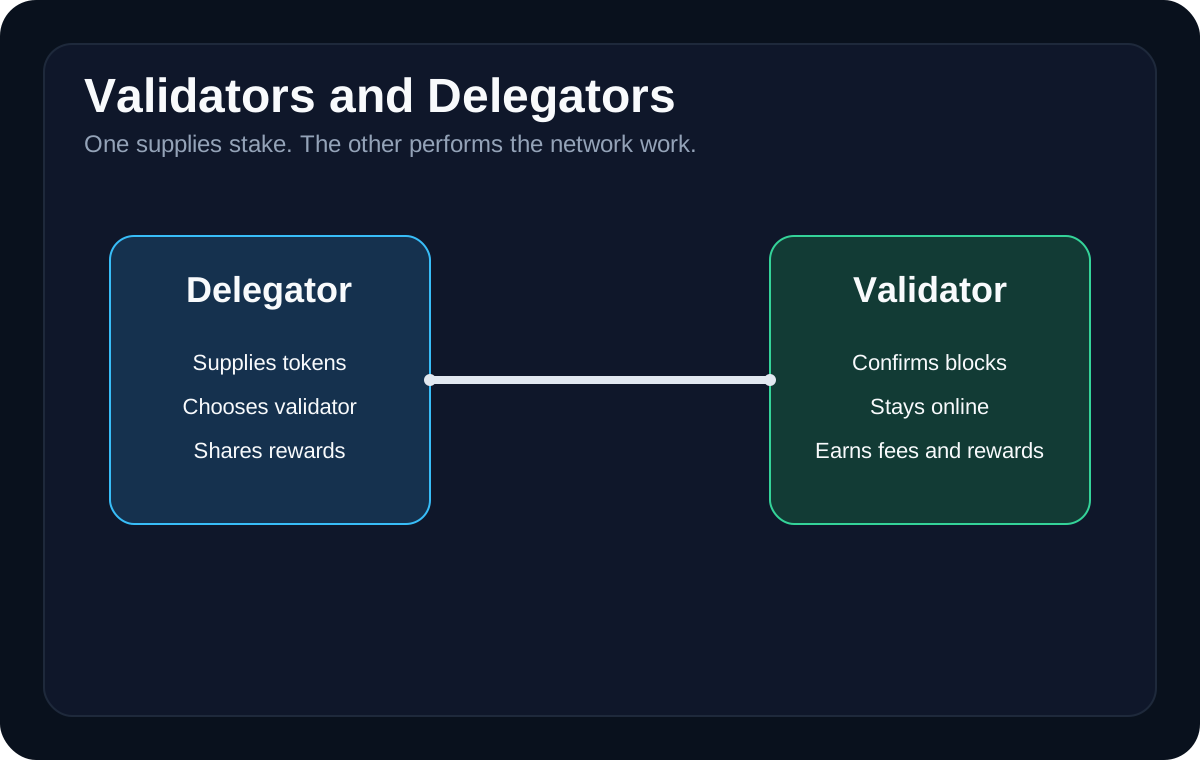
Validators do the work that keeps a proof-of-stake chain moving, while delegators supply stake without running the infrastructure themselves. A validator proposes or confirms blocks, and a delegator chooses which validator to trust with their stake. Why this matters: staking is not just locking tokens, it is choosing who helps secure the network on your behalf.
**How Staking Works** becomes easier to understand when you translate it into a user flow instead of a definition. In practice, learners usually meet this idea while *delegating SOL to a validator*, then discover that the visible app action sits on top of wallet permissions, network rules, liquidity, or settlement assumptions that are easy to miss the first time. That is why the safest beginner habit is to ask how the action works, what the hidden dependency is, and what part of the system would fail first under stress.
A common beginner mistake here is *treating staking APR like a savings account rate*. Another is *ignoring validator quality, lockups, and withdrawal timing*. Those errors usually do not come from bad intent; they come from skipping one layer of understanding and moving straight to the transaction. What can go wrong depends on the lesson, but the pattern is consistent: users either trust the wrong tool, underestimate timing and fees, or assume one network's rules apply everywhere. Slowing down long enough to verify the route, asset, counterparty, or contract address prevents a surprising share of early losses.
A useful way to test whether this idea is landing is to picture where it shows up in a real workflow. Someone might run into it while *delegating SOL to a validator* or *following Ethereum staking queues and validator performance*, which is why the topic matters most once money, permissions, or liquidity are already in motion instead of while reading definitions in the abstract.
**Why this matters:** How Staking Works is more useful when you can connect it to What Is Staking, Staking Rewards & Risks, and How Blockchains Work. That broader map helps beginners judge when the tool fits, when a simpler path is safer, and which follow-on topic to study next before committing real money or signing real transactions.
For primary-source context, see [Solana staking guide](https://solana.com/learn/what-is-staking), [Solana staking reference](https://solana.com/de/staking), and [Ethereum security report](https://ethereum.org/reports/trillion-dollar-security.pdf).
Visual Guides
How rewards are earned
Rewards usually come from new token issuance, transaction fees, or both. The exact amount changes based on how much total stake is in the network, how much a validator charges, and how reliably that validator performs. In simple terms: the reward rate moves because network conditions and validator quality change over time.
The real value of **how rewards are earned** is that it explains what is happening behind the button a beginner clicks. Whether someone is *following Ethereum staking queues and validator performance* or *comparing direct staking with liquid staking in ecosystems such as Lido or Cosmos*, the outcome depends on a chain of infrastructure choices such as custody, routing, execution, and final settlement. Once that chain is clear, the topic stops feeling like crypto magic and starts feeling like a system with understandable moving parts.
Most people do not get hurt by the concept itself. They get hurt by the shortcuts they take around it. *Ignoring validator quality, lockups, and withdrawal timing* can turn a simple workflow into an expensive mistake, and *adding smart-contract risk before understanding basic delegation first* often becomes visible only after funds are already in motion. That is why good crypto education pairs the mechanics with practical failure modes instead of teaching the upside in isolation.
Beginners usually retain this faster when they attach it to a concrete decision rather than a glossary term. In practice, the concept becomes easier to trust and easier to question once you connect it to a workflow like *following Ethereum staking queues and validator performance* and ask what could break, slow down, or become expensive at each step.
**Why this matters:** How Staking Works is more useful when you can connect it to What Is Staking, Staking Rewards & Risks, and How Blockchains Work. That broader map helps beginners judge when the tool fits, when a simpler path is safer, and which follow-on topic to study next before committing real money or signing real transactions.
Lockups and unbonding
Many staking systems include a lockup or unbonding period, which means you cannot move your tokens immediately after you decide to unstake. That delay matters because market conditions and validator problems can change while your funds are still waiting to unlock. What this means: staking can reduce flexibility even when the reward rate looks attractive.
**How Staking Works** becomes easier to understand when you translate it into a user flow instead of a definition. In practice, learners usually meet this idea while *comparing direct staking with liquid staking in ecosystems such as Lido or Cosmos*, then discover that the visible app action sits on top of wallet permissions, network rules, liquidity, or settlement assumptions that are easy to miss the first time. That is why the safest beginner habit is to ask how the action works, what the hidden dependency is, and what part of the system would fail first under stress.
Most people do not get hurt by the concept itself. They get hurt by the shortcuts they take around it. *Adding smart-contract risk before understanding basic delegation first* can turn a simple workflow into an expensive mistake, and *treating staking APR like a savings account rate* often becomes visible only after funds are already in motion. That is why good crypto education pairs the mechanics with practical failure modes instead of teaching the upside in isolation.
A useful way to test whether this idea is landing is to picture where it shows up in a real workflow. Someone might run into it while *comparing direct staking with liquid staking in ecosystems such as Lido or Cosmos* or *delegating SOL to a validator*, which is why the topic matters most once money, permissions, or liquidity are already in motion instead of while reading definitions in the abstract.
**Why this matters:** How Staking Works is more useful when you can connect it to What Is Staking, Staking Rewards & Risks, and How Blockchains Work. That broader map helps beginners judge when the tool fits, when a simpler path is safer, and which follow-on topic to study next before committing real money or signing real transactions.
Network security role
Staking turns token ownership into a security system for the network. Instead of relying on miners and large energy use, proof-of-stake chains rely on staked capital and validator rules to make attacks expensive and honest behavior worthwhile. Why this matters: the network stays safer because validators have something to lose if they break the rules.
The real value of **network security role** is that it explains what is happening behind the button a beginner clicks. Whether someone is *delegating SOL to a validator* or *following Ethereum staking queues and validator performance*, the outcome depends on a chain of infrastructure choices such as custody, routing, execution, and final settlement. Once that chain is clear, the topic stops feeling like crypto magic and starts feeling like a system with understandable moving parts.
A common beginner mistake here is *treating staking APR like a savings account rate*. Another is *ignoring validator quality, lockups, and withdrawal timing*. Those errors usually do not come from bad intent; they come from skipping one layer of understanding and moving straight to the transaction. What can go wrong depends on the lesson, but the pattern is consistent: users either trust the wrong tool, underestimate timing and fees, or assume one network's rules apply everywhere. Slowing down long enough to verify the route, asset, counterparty, or contract address prevents a surprising share of early losses.
Beginners usually retain this faster when they attach it to a concrete decision rather than a glossary term. In practice, the concept becomes easier to trust and easier to question once you connect it to a workflow like *delegating SOL to a validator* and ask what could break, slow down, or become expensive at each step.
**Why this matters:** How Staking Works is more useful when you can connect it to What Is Staking, Staking Rewards & Risks, and How Blockchains Work. That broader map helps beginners judge when the tool fits, when a simpler path is safer, and which follow-on topic to study next before committing real money or signing real transactions.
How the full staking flow fits together
A user stakes or delegates tokens, the network assigns that stake to validator activity, validators are selected to help process transactions, and the network pays rewards when work is done correctly. Next, the main question becomes whether the reward is worth the tradeoffs. In simple terms: your tokens support the network, and the network pays for that support when the validator performs well.
**How Staking Works** becomes easier to understand when you translate it into a user flow instead of a definition. In practice, learners usually meet this idea while *following Ethereum staking queues and validator performance*, then discover that the visible app action sits on top of wallet permissions, network rules, liquidity, or settlement assumptions that are easy to miss the first time. That is why the safest beginner habit is to ask how the action works, what the hidden dependency is, and what part of the system would fail first under stress.
Most people do not get hurt by the concept itself. They get hurt by the shortcuts they take around it. *Ignoring validator quality, lockups, and withdrawal timing* can turn a simple workflow into an expensive mistake, and *adding smart-contract risk before understanding basic delegation first* often becomes visible only after funds are already in motion. That is why good crypto education pairs the mechanics with practical failure modes instead of teaching the upside in isolation.
A useful way to test whether this idea is landing is to picture where it shows up in a real workflow. Someone might run into it while *following Ethereum staking queues and validator performance* or *comparing direct staking with liquid staking in ecosystems such as Lido or Cosmos*, which is why the topic matters most once money, permissions, or liquidity are already in motion instead of while reading definitions in the abstract.
**Why this matters:** How Staking Works is more useful when you can connect it to What Is Staking, Staking Rewards & Risks, and How Blockchains Work. That broader map helps beginners judge when the tool fits, when a simpler path is safer, and which follow-on topic to study next before committing real money or signing real transactions.
- Choose a proof-of-stake network and a staking method.
- Assign tokens to a validator directly or through delegation.
- Wait for the validator to be selected for block work.
- Let the network confirm valid blocks and transactions.
- Receive rewards after fees, commissions, and network rules are applied.
Visual Guides
What validator selection really means
Validator selection is one of the least understood parts of staking. Most proof-of-stake networks choose validators using rules that are random, stake-weighted, or both, which means not every validator gets the same number of opportunities. Why this matters: selection rules help explain why larger validators often earn more often, but also why performance and network design still matter.
The real value of **what validator selection really means** is that it explains what is happening behind the button a beginner clicks. Whether someone is *comparing direct staking with liquid staking in ecosystems such as Lido or Cosmos* or *delegating SOL to a validator*, the outcome depends on a chain of infrastructure choices such as custody, routing, execution, and final settlement. Once that chain is clear, the topic stops feeling like crypto magic and starts feeling like a system with understandable moving parts.
Most people do not get hurt by the concept itself. They get hurt by the shortcuts they take around it. *Adding smart-contract risk before understanding basic delegation first* can turn a simple workflow into an expensive mistake, and *treating staking APR like a savings account rate* often becomes visible only after funds are already in motion. That is why good crypto education pairs the mechanics with practical failure modes instead of teaching the upside in isolation.
Beginners usually retain this faster when they attach it to a concrete decision rather than a glossary term. In practice, the concept becomes easier to trust and easier to question once you connect it to a workflow like *comparing direct staking with liquid staking in ecosystems such as Lido or Cosmos* and ask what could break, slow down, or become expensive at each step.
**Why this matters:** How Staking Works is more useful when you can connect it to What Is Staking, Staking Rewards & Risks, and How Blockchains Work. That broader map helps beginners judge when the tool fits, when a simpler path is safer, and which follow-on topic to study next before committing real money or signing real transactions.
- Selection is usually influenced by stake size and protocol rules.
- A validator with more stake may appear more often, but not automatically every time.
- Reliable performance matters because bad uptime can still hurt results even when stake is large.
Why the mechanics matter for beginners
It is easy to think staking is just a button inside a wallet, but the mechanics underneath determine whether rewards are steady, withdrawals are slow, or validator mistakes become expensive. Once you understand the moving parts, the next step is judging whether the reward is worth the risk. In simple terms: simple user interfaces can hide complex rules underneath.
**How Staking Works** becomes easier to understand when you translate it into a user flow instead of a definition. In practice, learners usually meet this idea while *delegating SOL to a validator*, then discover that the visible app action sits on top of wallet permissions, network rules, liquidity, or settlement assumptions that are easy to miss the first time. That is why the safest beginner habit is to ask how the action works, what the hidden dependency is, and what part of the system would fail first under stress.
A common beginner mistake here is *treating staking APR like a savings account rate*. Another is *ignoring validator quality, lockups, and withdrawal timing*. Those errors usually do not come from bad intent; they come from skipping one layer of understanding and moving straight to the transaction. What can go wrong depends on the lesson, but the pattern is consistent: users either trust the wrong tool, underestimate timing and fees, or assume one network's rules apply everywhere. Slowing down long enough to verify the route, asset, counterparty, or contract address prevents a surprising share of early losses.
A useful way to test whether this idea is landing is to picture where it shows up in a real workflow. Someone might run into it while *delegating SOL to a validator* or *following Ethereum staking queues and validator performance*, which is why the topic matters most once money, permissions, or liquidity are already in motion instead of while reading definitions in the abstract.
**Why this matters:** How Staking Works is more useful when you can connect it to What Is Staking, Staking Rewards & Risks, and How Blockchains Work. That broader map helps beginners judge when the tool fits, when a simpler path is safer, and which follow-on topic to study next before committing real money or signing real transactions.
Glossary
- Validators and delegators
- Validators do the work that keeps a proof-of-stake chain moving, while delegators supply stake without running the infrastructure themselves. A validator proposes or confirms blocks, and a delegator chooses which validator to trust with their stake.
- How rewards are earned
- Rewards usually come from new token issuance, transaction fees, or both. The exact amount changes based on how much total stake is in the network, how much a validator charges, and how reliably that validator performs.
- Lockups and unbonding
- Many staking systems include a lockup or unbonding period, which means you cannot move your tokens immediately after you decide to unstake. That delay matters because market conditions and validator problems can change while your funds are still waiting to unlock.
- Network security role
- Staking turns token ownership into a security system for the network. Instead of relying on miners and large energy use, proof-of-stake chains rely on staked capital and validator rules to make attacks expensive and honest behavior worthwhile.
FAQ
Do validators always get selected equally?
No. Selection usually depends on network rules and is often weighted by how much stake a validator controls. Larger or more reliable validators may appear more often, but every network handles this differently.
Where do staking rewards come from?
Most rewards come from new token issuance, transaction fees, or both. The exact source depends on the blockchain you are using.
Why does validator choice matter?
Validator choice affects uptime, fees, and risk. A weak validator can reduce rewards or increase the chance of penalties on some networks.
Can you move staked tokens immediately?
Usually not. Many networks use lockups or unbonding periods that delay withdrawals even after you decide to unstake.
Does more stake always mean more reward?
More stake can increase your reward share, but it does not guarantee better results. Fees, validator performance, and token price still matter.
Is delegated staking easier than running a validator?
Yes, for most beginners. Delegation removes the infrastructure work, but you still need to evaluate validator quality and network rules.